Like always, the meeting was held on the second Sunday of the month, which fell on 8 December this time. The meeting started with beautiful recitation of Quran by Jameel Bhatti sahib, after that Fatiha was recited for those friends who are no longer with us. Then buying, selling, and gossiping started. Today Salman Baseer Sahib also came to the meeting as he was visiting from USA after around a year. Salman Sahib presented tickets as a gift to the friends present in the meeting. As always, the meeting ended with the love and sincerity of Jameel Bhatti. Tea, samosas and jalebis added to the enjoyment of the season.
Here, I will be sharing all the Philatelic information from 1947 till now. Starting from 2024, I'll be going backwards and will give all the material with photos for reference to the context.
Tuesday, December 10, 2024
Tuesday, November 19, 2024
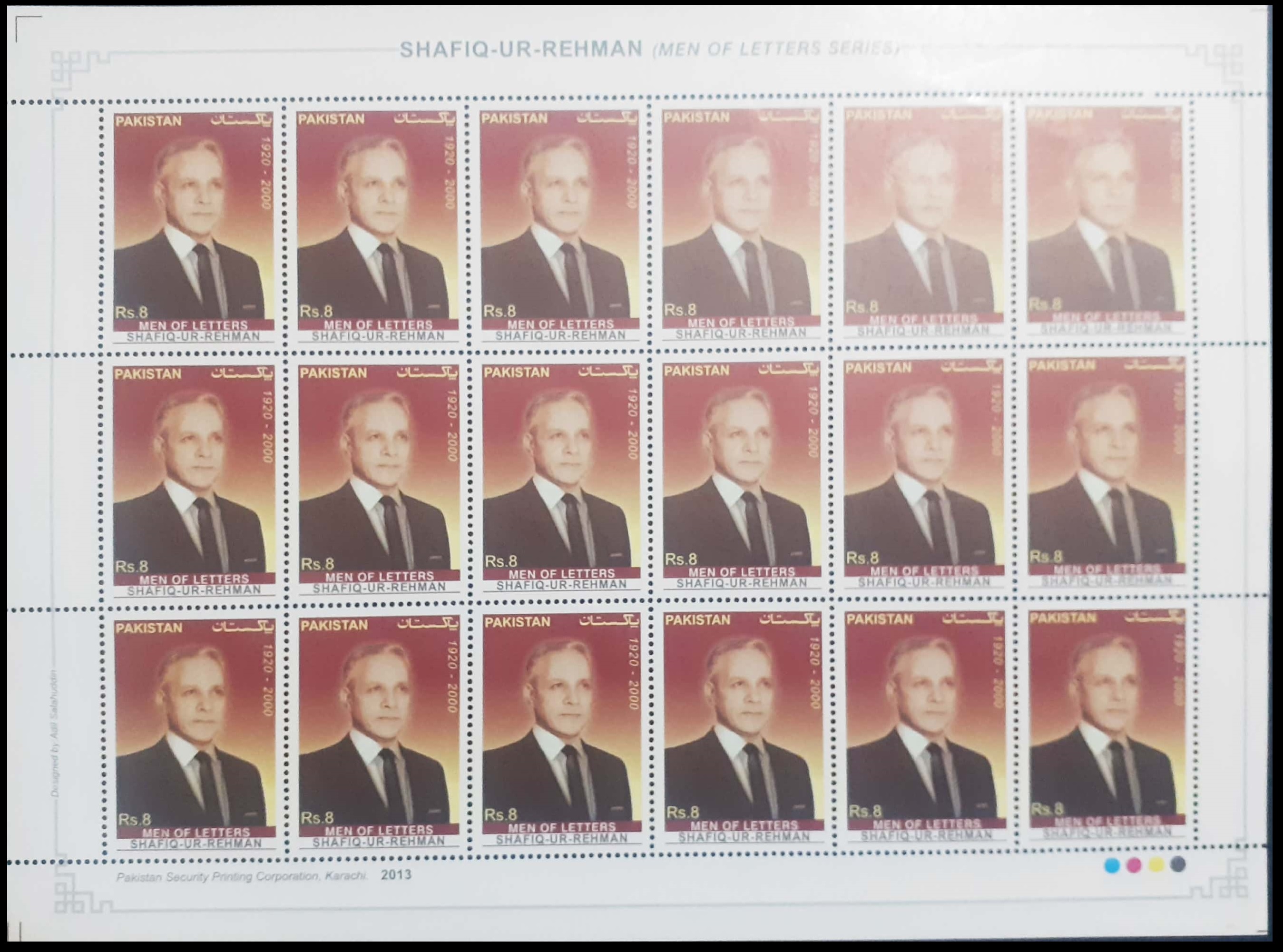
Men of Letters Series 'Shafiq-UR-Rehman' Issue Date:- 06-06-2013 (2013-13)
He was born on November 9, 1920
in a small town near Rohtak, India. Shafiq-ur-Rehman was an illustrious
humorist and a short-story writer of Urdu language. He was a medical Doctor by
profession, and served in Pakistan Army.
He received his education in
Bahawalpur. He completed his MBBS from King Edward Medical College Lahore in
1942, and post-graduation in 1952. He began writing humorous stories during his
school days.
His stories were published in a
literary monthly magazine “Khayyam”. His book “Kirnain” was completed before he
joined medical college and it was published in 1938 while he was still a
medical student. It was followed by Shagoofay, Lehrain, Maddojazar, Parvaaz,
Himaqatain, Mazeed Himaqatain, Dajla (a travelogue), Insaani tamasha (a
translation of “a human comedy”) and lastly Dareechay.
Though he was a humorist, but
generally there is an air of romance I his writings. Early in his career, he
became a household name. His popularity increased manifold from his second book
“Shagoofay”
His later books “Lehrain” and
“Parvaaz” further established him as a high class humorist. His wit and
repartee put him way ahead of some of his contemporaries. Though his humor is
not shy of practical jokes, he uses it sparingly. His jokes have meaning beneath
the surface but on the outside they amused everyone to laugh.
As far as parodies are concerned,
hardly any humorist in urdu can reach his level in satire and wit. His five
parodies “Qissa Chahar Darvesh”, Qassa-i-Hatim Tai bai tasweer”, Qissa Professor
Ali Baba Ka”, “Tuzk-i-Nadri urf siyahat nama-i-Hinda” and “Safar nama Jahazbad
Sindhi Ka” are fine satires on our history and culture.
Shafiq became very popular among
adolescent. He often philosophizes about joys and sorrows, sweeping the young
readers with the bouts of optimism and pessimism, giving semi-philosophical,
semi-romantic explanations to the queries that haunt the youth. In Urdu
Language his style is comparable to that of Stephen Leacock and Mark Twain in
English Literature.
He continued to write till his
death. He gave a new look to Urdu humor and is the inspiration for many of the
Leading humorists nowadays. He created a world that was very real with all its
joys, pains and anguish. It was an affirmation of human values and compassion.
The Language he used is simple and spontaneous.
His unforgettable characters
include Shaitaan, Hukoomat Aapa, Maqsood Ghora, Buddy, Nannha and others. He
ruled the world of humor for almost 60 years.
Shafiq-ur-Rehman joined the
Indian Army Medical Corps and served at different war fronts during ther Second
World War. After partition, he joined the Pakistan Army and rose to the rank of
Major General. After his retirement, he served as Chairman of the Academy of
letters of Pakistan from 1980 to 1985. During his tenure, the Academy of
Letters really flourished and touched its zenith as a Literary Institution.
Grief came to his happy life in
the shape of sad death of his son Khalique on account of an accident and his
wife’s prolonged illness. He died on March 19, 2000 in Rawalpindi. He was
awarded the Hilal-e-Imtiaz for his military and civilian services on March 23,
2001 after his death.
He wrote following books:-
1. Kirnain
2. Shagoofay
3. Lehrain
4. Madd-o-Jazar
5. Pachtaway
6. Parwaaz
7. Himaqatain
8. Mazeed
Himaqatain
9. Dajlah
10. Insaani
Tamasha (a translation)
11. Dareechay
On Men of Letters Series Shafiq-ur-Rehman, Pakistan Post is issuing a Commemorative Postage Stamp of Rs.8/- denomination on June 6, 2013.
100 Years of Islamia College Peshawar, Pakistan. (2013-12)
100 Years of Islamia College
Peshawar Commemorative Postage Stamp May 30, 2013:- Nawab Sir Sahibzada Abdul
Qaiyum Khan, hailing from Topi, district Swabi, had founded the Islamia
College in 1913. He was a reformer and
educationist par excellence. He had a strong feeling of the educational
backwardness of Pushtuns living in NWFP and the tribal belt surrounding it.
This infused in him an religious and scientific educational disciplines under
one roof.
The idea of Islamia College moved
on practical track in April 1911. A supervisory committee with Sahibzada Sahib
as its first honorary secretary kicked off a donations campaign. Pushtun
students enrolled at the Muslim University Aligarh, had already taken lead in
this noble task. In 1909, when Sahibzada Sahib and Roos Keppel had made a
stopover at Aligarh, these students had collectively donated sixty odd rupees
to these dignitaries. The purpose was to build a Frontier hostel at Aligarh or
to erect a college in Peshawar for them.
However, the 12th of April 1911
donations collection gathering held at the residence of Abdul Karim Khan
Indrabi Contractor in Mohallah Mandi-Beri, Peshawar City may be remembered as
the Islamia College’s founders meeting.
The vast chunk of land on which
Islamia College has been standing like a beacon of knowledge and wisdom for
nearly a century, is located almost at the mouth of historic Khyber Pass. Here
were the relics of a second century A.D. Buddhist monastery where knowledge
seekers used to come from far off places. Incidentally, this was the same big
piece of land on which the valiant Afghans under Mohammad Akbar Khan had routed
the armies of Harri Singh, a military commander of Maharaja Ranjit Singh in
1835. Khalils of Tehkal who were its owners, gave their consent for 916 Kanals
and 17 marlas land to the college against Rs.39, 683 at the rate of Rs.30/- per
Kanal.
Eminent freedom tighter, Haji
Sahib Turangzai laid the foundation stone of the Darul Ulum and its magnificent
mosque on 21st of March 1912. The Chief Commissioner, NWFP, Sir George Roos
Keppel performed the inaugural ceremony of arts and science faculty building of
the Islamia College the same day. A huge gathering of around 25-30 thousands
people including elite and commoners, top British officials, Ulema and Afridi
hill tribesmen witnessed this historic event, which put a tradition-bound
warring nation on scientific education track for the first time in its
thousands years old history.
The history of Islamia College as
a movement would remain incomplete if it does not have some extracts from the
history of freedom struggle for Pakistan. Its students played a very pivotal
role in Pakistan Movement. Credit goes to Islamians for coining the name of a
future Muslim state to be curved out of the British-Indian Empire in the
northwest of India as “Pakistan” in March 1933.
The Founder of Pakistan,
Quaid-e-Azam Muhammad Ali Jinnah had visited Islamia College thrice. His first
visit to this outpost of culture and civilization was on20th October 1936. He
visited in the capacity of President, All India Muslim League. Professor R. H.
Holdsworth, the Pricipal and Yusaf Khalil, President of Khyber Union greeted
him in historic Roos Keppel Hall. He was honoured with life-membership of the
Khyber Union. In his historic address on this occasion, he expressed optimism
that one day Islamia College would achieve Al-Azher and Cordova grandeur.
Quaid-e-Azam Muhammad Ali
Jinnah’s political stature was at the peak of its glory. The realization of the
cherished dream of Pakistan was at hands distance when he undertook his second
historic visit to this great seat of learning on 25th November 1945. Most of
the students of the Islamia College were in the bodyguard contingent of Quaid.
He was accorded an unprecedented and red carpet welcome at the Islamia College.
The Principal, Professor Sheikh Muhammad Taimur, the President of Khyber Union,
Mukhtar Ahmad and the secretary, Sarhad Muslim Students Federation, Muhammad
Tehmas, affectionately known as Papa, paid rich tributes to the farsightedness,
political acumen and leadership qualities of Quaid-e-Azam. The Quaid had in
fact designated the Islamia College students for mustering support for
Pakistan, which they successfully won.
Pakistan emerged on the map of
the world as a sovereign state on 14th of August 1947. The Islamia College
students fought pitched political battles for Pakistan on Quaid’s behalf in
cities, towns and villages of the province and tribal territories. How Quaid
could forget them. Hardly eight months after the making of Pakistan, he
revisted Islamia College and the NWFP for the third and last time in his life.
It was 12th of April 1948 that Quaid came to this historic institution as
governor general of an independent state. His dearest sister, Miss. Fatima
Jinnah accompanied him in this last visit to Frontier province taking off from Islamia
College. The college Principal, Professor ACT Brotherton and Abdul Halim, an
ideological homeland for the Muslims in the South Asia.
The Father of the Nation
acknowledged the services of the Islamia College students towards making of
Pakistan in these words:
“I am indeed very happy to be
present here today and to have the privilege of addressing the students of this
great Darul Ulum, who are the future builders of Pakistan. On this occasion the
thing uppermost in my mind is the help that came for the movement and
achievement of Pakistan from the student community, particularly from this
province. May I say that you have played your part magnificently?”
The Islamia College, its
Collegiate School and its mosque are a unique combination of Buddhist, Islamic
and Gothic architectures. The dooms at the rooftop of the college building are
on Buddhist stupa style. A large number of small, medium and large sixe
minarets and arches represent Islamic architecture. While the building’s shape
gives a reflection of Gothic architecture, the front view of its building is
like the University of Aligarh of India. However, Islamic architecture is more
visible in Islamia College’s front view. Its Islamic architecture is more close
to the Gordon College, Khartoum, Sudan. The image of the main building of
Islamia College is printed on the Rs. 1000 currency note.
The Islamia College put its first
step on unending journey of knowledge and wisdom on 1st of October 1913, six
months after the inauguration of school. Like its unique architecture, its
educational curriculum was also unique. It was designed to hand down the
benefits of western arts and sciences under the umbrella of Islamic precepts to
the people of NWFP and its tribal areas. The Darul Ulum, in this manner,
enjoined the two parallel Muslim renaissance movements of late nineteenth
century – the Devband and the Aligarh. This gave birth to a new unifield
movement towards Muslims reawakening in the northwestern corner of
British-India. This new movement was called the Islamia College movement.
Islamia College emerged as a
beacon of scientific knowledge and torchbearer of supreme ethical and religious
values. Nearly a century long journey, the college has become an icon of
academic par excellence. Its motto is “Rab-I-Zidni Ilma” (O Lord, enhance me in
knowledge). Allah the Almighty has bestowed His special blessing on this Darul
Ulum. The college, which began its educational voyage with just 33 students in
1913, after 100 years of its sailing has more than 9500 students today. It has
sent to practical field more than 80,000 students so far, who are serving the
country and the nation.
Modernity came hand-in-hand to
this area with the establishment of Islamia College in 1913. The Indian Postal
and Telegraph Department established a post-cum-telegraph office near Islamia
College in early 1914. The college authorities granted two rooms to the post
office in 1915 to cater the communication needs of around 300 Islamian campus
residents. This post office was shifted to Khyber House in 1917, when a market
was emerged here, which is commonly known today as Coffee Shop Bazaar. This
post office has been lifted to the status of Post Mall today.
An institution which went on
spreading enlightenment and fragrance of knowledge and wisdom in 1913 with only
ten teachers, today have more than 150 teachers of whom twenty-five have Ph.D
degrees while twenty-two teachers have M.Phil degrees. Twenty-four teaching
departments have been accommodating more than 9500 students at intermediate,
degree and post-degree level. An educational institution is a place where if
any thing is most needed it is discipline. It teaches students the value of
time, it infuses in them a spirit of doing things systematically and it also
builds the character of individuals.
Libraries are treasurers and
storehouses of knowledge and wisdom. The new portion hosts most modern books on
a large number of subjects. The Islamia College library has seen a steady
growth in its collection of books. Around 1930, its oriental collection of
books multiplied many times when a handsome amount of thirty thousand rupees
was sanctioned. In 1963-64, the collection of books rose to forty thousand. The
total number of books in this library went up to seventy-five thousands in
1988. Today, the library houses more than eighty-five thousand books.
At present, Islamia College
library is among the finest libraries of this region after burning down and
theft of libraries in Kabul because of civil war in Afghanistan. However, a
good number of books on Afghanistan, NWFP and its tribal belt, with their first
editions, both printed in Great Britain and Kabul, are available in the Islamia
College library.
Like academics, the performance
of Islamia College students in sports has always been superb. The college gave
two captains to Pakistan National Hockey Team. Its Brigadier Hameedi steered
Pakistan to victory against India in Hockey in the Rome Olympics 1960. Late
Qazi Mohib also remained the captain of Pakistan national squad in Hockey for
many years in 1980’s.
Khyber Union Hall is the
epicenter of co-curricular activities on Islamia College campus. It had now
become a relic of students’ union days. The Islamians elected body used to be
called Khyber Union and it continued to
function from 1921 to 1983 until the students unions elections were
declared illegal in the educational institutions.
The Khyber Union has so far
granted honorary life-membership to a number of distinguished personalities in
different fields of life. They are Sir Mian Mohammad Shafi (1922), Nawab Sir
Sahibzada Abdul Qaiyum Khan (1922), Sir Shuja-ul-Mulk, Mether of Chitral
(1924), Khan Bahadur Mian FAzli Hussain, education minister, government of
India (1925), Shah Wali Khan, Afghan Ambassador to Great Britain (1929), Prince
Azam Jah of Hyderabad Deccan, India (1930), Shahzada Muazzam Jah of Deccan
(1930), Sir Ralph Griffith, governor of NWFP (1934), Khalida Adeeb Khanum, a
prolific writer of Turkey (1935), Sir Abdur Rahim, president of legislative
assembly (1935), Muhammad Ali Jinnah, President of All India Muslim League
(1936), Jawaher Lal Nahru, President of Indian National Congress (1937),
Mahatama Gandhi (1938), His Highness Muhammad Nasirul Mulk, Mehter of Chitral
(1938), Maulana Abul Kalam Azad (1939), Sir Akbar Hydari (1940), His Highness
Nawab Hamidullah Khan, Nawab of Bhopal (1942), Sir George Cunningham, governor
of NWFP (1943), Sardar Abdur Rab Nishtar, communication minister, government of
India (1947), Alhaj Khawja Nazimuddinn, governor-general of Pakistan (1948),
FAzlur Rehman, education minister, government of Pakistan (1949), Dr. Mahud
Hussain, education advisor, government of Pakistan (1949), His Majesty Mohammad
Raza Shah Pehlvi of Iran (1950), Mir Laiq Ali, former prime minister, Hyderabad
Deccan (1951), Mrs. Eleanor Roosevelt (1952), Sardar Abdur Rashid Khan, chief
minister of NWFP (1954), Qurban Ali Khan, governor of NWFP (1955), Khan Abdul
Qayyum Khan, chief minister NWFP (1956), Mohtarma Fatima Jinnah (1962) and Dr.
Abdul Qadeer Khan, Pakistan’s nuclear scientist (2002).
The students and teachers of
Islamia College have always felt themselves indebted to their alma mater. The
first tribute to the dignified building of Islamia College came from Mrs.
Tipping, the wife of British Principal of the college, Professor. L. Tipping in
1913. An oil painting made by her of this college is a masterpiece of painting
today. The photograph/CD of this is being sent for issue of commemorative
stamp.
The lush green Campus of Islamia
College is virtually like a paradise. The barren piece of land on which Islamia
College was established in 1913 has turned into a grassy and flowery garden on
a 300 acres area in the course of time. When breeze blows across Islamia
College, it spreads fragrance all around of knowledge, enlightenment and
affection. Its tall trees kissing the forehead of skies tell the story of those
who dedicated their lives in turning a desert into an oasis. A few yards away
along the western gate of Islamia College are standing two giant trees of
Salmalia (Sumbul). Therse are the forerunners of a queue of lofty Pistacia,
Plantanus (Chinar), Ficus Relgiosa (Peepal) and Shesham trees on Islamia
campus. The vast grassy grounds with multiple coloures eye-catching flower
lanes at their boundaries lend Islamia College landscape a touch of heaven.
Islamia College is proud to have
a galaxy of old guards who take keen interest in the well being of the college,
its academics and other kinds of co-curricular activities. This gamut of former
students is called Senior Alumni Association of Islamia College. It reorganized
its work in the year 2000. More than 650 former students of the college are its
members. The Senior Alumni is playing a very important and serious role in
financially assisting the deserving and academically outstanding students in
the pursuit of knowledge. It grants 150 scholarships from its NWFP and
Islamabad chapter resources annually since 2000. Alot a total of Rs.4428000 has
so for been contributed by SAA towards students welfare. The Senior Alumni is
also working on compiling a comprehensive history of the Islamia College
Peshawar to be published on centenary celebrations of Islamia College in 2013.
Some of the illustrious personalities of ICP are one president Ghulam Ishaq
Khan to Islamic Republic of Pakistan and 9 Governors to Khyber Pukhtunkhwa.
Such as Col Khurshid Sahibzada, Mr. Aslam Khattak, Mr. Hayat Muhammad Khan
Sherpao, Arbab Sikandar Khan Khalil, Maj Gen (R). Khurshid Ali Khan, Comdr
Khalil ur Rehman, Lt Gen (R). Ali Muhammad Jan Aurakzai and Lt Gen (R).
Imranullah Khan Ex Governor Balochistan.
It was the heartiest desire of
Sir Sahibzada Abdul Qaiyum Khan – the Sir Syed of Sarhad – that the Darul Ulum
should become a university one day. He expressed this desire while welcoming
the new NWFP Governor Sir Hamilton Grant on 20th December 1919 on behalf of the
Board of Trustees of the College. No authentic historical record is available
to answer as to why this desire of Nawazada S. A. Qaiyum remained unfulfilled.
However, after the creation of Pakistan, Quaid-e-Azam Muhammad Ali Jinnah
visited Islamia College for the last time in his life in April 1948. He
promised a university here. His trusted lieutenant, Nawabzada Liaquat Ali Khan
fulfilled this promise by inaugurating University of Peshawar in October 1950.
The government of Pakistan kept intact the historic status of Islamia College
and allocated university in its immediate neighborhood.
However, the Islamians – both old
and new boys and teachers, continued their struggle for up gradation of their
college to university level so as to pay homage and tribute to its founders who
also thought of a university on the ICP campus. Their efforts, particularly, of
Senior Alumni, bore fruit on December 4, 2007, when after 94 years of the
establishment of Islamia College, found the status of a public sector
university.
The former NWFP governor,
Lt.-Gen. (retired) Ali Muhammad Jan Aurakzai and the then provincial caretaker
chief minister, Engineer Shamsul Mulk, both old Islamians, deserve special
thanks for taking up seriously the matter of upgrading ICP to university level.
The groundwork in the direction of turning ICP into ICUP was carried out during
the Principalship of Professor Dr. Nisar Muhammad Nisar, who also deserves
equal appreciation from Islamians.
The Islamia College Peshawar came
up to its age in September 2007 with the launching of its girls section under
the administrative and academic competence of Professor Nisar Muhammad Nisar.
The introduction of female education on a campus which remained reserved for
males for around a century was certainly an uphill task. But the efforts of a
century for enlightenment in a traditions-bound society anyhow made inroads.
On Completion of 100 years of Islamia College Peshawar, Pakistan Post is issuing a commemorative postage stamp of Rs..8/- denomination on May 30, 2013.
Men of Letters Series Syed Zamir Jafri (1916-1999) (2013-11)
Syed Zamir Jafri (1st January
1916-12 May 1999) was born in Chak Abdul Khaliq near Dina, district Jhelum. He
was a legendary poet with unique poetic diction and fresh ideas. A scholar and
trendsetter in humorous poetry in tandem with serious poetry. He was a true
patriot who effectively made his pen a source of preaching the message of peace
and love for mankind. His writing are a valuable asset of Urdu literature. He
has on his credit over 70 published books of poetry and prose, which represent
a varied range of creative works.
Syed Zamir Jafri was a renowned
humorist, columnist, broadcaster and telecaster wrote in Urdu, Punjabi and
English. In addition to original works, he also translated into Urdu verse
“Malay Folk Lore” (Pantuns) of Malaysia, along with a few poems from
Nazar-ul-Islam (Bangali) and translations from the monumental Punjabi classic,
the “Saif-ul-Malook”. As a humorist, he had his stamp of his own, making him
the most sought after poet in poet recitals (Mushiara) within the country and
abroad. As a Co-Editor, he was responsible for production of the “Urdu Punch”
the most sophisticated and esteemed journal of Urdu humour. After graduating
from Islamia College Lahore, he started his career as a journalist in Lahore
but soon after joined the Royal Indian Army War Propaganda Directorate when the
Second World War started. After serving at the headquarters in Delhi he was
posted in the Far East. After independence, he continued to serve in the
Education Corps of Pakistan Army and participated in the 1948 Kashmir
liberation and 1965 Indo-Pak War. He held various staff and field assignments
including Pakistan Military Academy and Inter Service Public Relations
Directorate. In 1965 he retired from the Army as a Major and thereafter, was
appointed as the first Director Public Relations of Capital Development
Authority (CDA). He remained on this post for over fifteen years and had the
honour of naming the roads and residential / commercial sectors of the new
capital. He then served on contract assignments as the Deputy Director General
of Pakistan National Centre and then as Advisor to the Chief Commissioner
Afghan Refugees and lastly as the Chief Editor in Academy of Letters.
Syed Zamir Jafri wrote serious
and humorous poetry, but his letter form of writing gained more popularity and
recognition. He had knack of combining serious and even grim facts with humour.
He seldom used irony, burlesque or horse laughter in his writings; but brought
within its level of pure humour, apparently non serious, and some time
nonsensical as defined in literary criticism. His poetic process can be seen at
its best in his most popular collection “Mafiz-Zamir”. This anthology presents
Syed Zamir Jafri as a cultured and sophisticated humourist.
Syed Zamir Jafri paints
environment from an objective point of view, which reflects his subjective
response to it. His inspiration by his passion for reform is evident but his
satire is not very loud. This is illustrated in the poetic journey he traversed
from 1947 to 1974. During this period, he had become a very popular poet who
was invited to Mushairas in Pakistan and abroad – to India, countries of
Europe, Middle East and North America. He was awarded with the
Tamgha-e-Quaid-e-Azam in 1967 and the President’s Pride of Performance in 1985
in recognitions of his services in the field of Urdu literature.
Syed Zamir Jafri was also famous
for his serious poetry. His collection titled, “Kalyan” comprises ghazals and
short poems. They deal with the experiences of love and personal relations,
besides th social and class relationships. His greatest contribution in serious
poetry consists of national songs (Tranas), which he wrote at different
national occasions. He was thus looked upon as an important poet who is
patriotic and loyal to the country. He declined the acceptance of the “Akbar
Allahabadi Cash Award” announced by India in 1990 as a protest against Indian
atrocities in the Indian-held Kashmir. He also wrote some prose books but most
of all, the prized ones were his diaries written from his student days till his
demise. He thus followed old poetic models, with almost perfect command over
the Urdu language. He developed a catholic taste for poetry of various kinds
and different poetic rhythms in numerous forms. Syed Zamir Jafri died on 12 May
1999 in New York, USA, leaving behind his unmatched work for lovers of Urdu
literature. His services in blending the art of serious and humorous poetry in
Urdu language will always be remembered. “Syed Zamir Jafri Foundation” was formed
soon after his death to preserve and promote his literary works.
On Men of Letters Series Syed Zamir Jafri, Pakistan Post is issuing a Commemorative Postage Stamp of Rs.8/- denomination on May 29, 2013.
Pioneers of Freedom Series Nawab Sadiq Muhammad Khan Abbasi V. (1904-1966) (2013-10)
Pioneers Of Freedom Series Nawab
Sadiq Muhammad Khan Abbasi V (1904 – 1966) Commemorative Postage Stamp May 24,
2013:- General Nawab Sadiq Muhammad Khan Abbasi V 29, September 1904 – 24 May
1966) was the Nawab, and later Amir, of Bahawalpur State from 1907 to 1966. He
became the Nawab on the death of his father, when he was only three years old.
A Council of Regency, with Sir Rahim Bakhsh as its President, ruled on his
behalf until 1924. The Nawab served as an officer with the Indian Army,
fighting in the Third Afghan War (1919) and commanding forces in the Middle
East during the Second World War. In August 1947, the Nawab received the title
of Amir of Bahawalpur, acceding his State to the Dominion of Pakistan a month
later. In 1955, the Amir was promoted to General in the Pakistan Army and
merged his state into West Pakistan. He died in 1966, aged 61. Under his rule
Bahawalpur State comprised an area larger than Denmark or Belgium. By 1947
Bahawalpur State’s institutions, largely set up by successive British advisors
with support from the rulers, consisted of departments run by trained civil
servants; there was a Ministerial Cabinet headed by a Prime Minister; the State
Bank was the Bank of Bahawalpur with branches outside the State also, including
Karachi; there was a high court and lower courts; a trained police force and an
army commanded by officers trained at the Royal Indian Military Academy Dehra
Dhoon. Nawab had a keen interest in education, which was free till A-level and
the State’s Government provided scholarships of merit for higher education not
only for its own citizens but also brilliant Muslim students of whole India. In
1951, the Nawab donated 450 acres in Bahawalpur for the construction of Sadiq
Public School. Nawab was known for his relationship with the Quaid-i-Azam,
Founder of Pakistan.
Early Life:- Sir Sadiq Muhammad
Khan Abbasi was born at Doulat Khan, Bahawalpur on 29 September 1904, the only
son and heir of Haji Nawab Muhammad Bahawal Khan Abbasi V, Nawab of the state
of Bahawalpur. When only two and a helf, his father fell ill and died while at
sea off the Adencoast, on 15 February 1907, leaving Sadiq as ruler of
Bahawalpur. He was educated at Aitchision College, Lahore. At the age of 15,
Sadiq fought in the Third Afghan War in 1919, was knighted in 1922 when he
reached his majority and was invested with the throne two years later by Lord
Reading. In 1929 he visited Egypt and was a guest of the King. Very fond of
cars, he bought a Rolls Royce Phantom car, one of the two Cars on display at
the Cairo Show. Here he contracted a marriage with an Ottoman princess,
divorcing one of his previous wives. He signed the Muslim marriage certificate
(Niqahu) on 6 October 1929. Sadiq valued education and cultural sophistication
in women, but Princess Hamide Nermin Nezahat Sultan lacked these. She had
receivd no formal education but was skilled in needlework and liked playing
card games. She could read and write, but only in Turkish and French. Princess
Hamide Nermin Nezahat Sultan was considered gentle, virtuous, and docile, that
made her a suitable candidate for Sadiq. After the first meeting, Sadiq was
extremely disappointed with his new bride. He found HIH Princess Hamide Nermin
Nezahat Sultan humorless and boring. After two years, the marriage ended in
divorce.
Ruler of Bahawalpur:- The
Bahawalpur State under his rule was considered to be an important sovereign
state in Sub Continent. The Bahawalpur State had a special privilege as it was
larger than some states of the present time like Lebanon, Kuwait, Israel and
Denmark in respect of area. Its population was two times more than the total
population of United Arab Emirates. Its rulers also enjoyed special protocol
and titles conferred by the British since 1866 as they were accorded 17 canons
salute and had special access to the Viceroy
of British India Bahawalpur state also had a separate mint to cast coins
for its public and the facility remained intact until 1940. The British
Government extablished a Regency Council under the supervision of Maulvi Sir
Rahim Bakhsh until the minor Nawab grew up as a young man. This Council was
responsible for state administration. Special attention was paid to the
education and upbringing of Nawab Sadiq Muhammad Khan (V). He started his
education from Atchison College, Lahore and completed in England. He had an aptitude
for military affairs and achieved several military titles, conferred on him by
the British Empire. The Viceroy of India, Reading awarded total authority of
the state administration to Nawab Sadiq Muhammad Khan (V) on March 8, 1924.
Sir Sadiq continued his military
career in the British Indian Army, which he had begun as a Lieutenant in 1921;
by 1932 he was a Major, by 1941 a Lieutenant Colonel, commanding troops in the
Middle East during the Second World War. Since 1921, he had also been a Member
of the Chamber of Princes, and since 1940, a member of the Indian Defance
Council. Promoted to Major-General in 1946, the following year, on 15 August
1947, Sir Sadiq was promoted to the title of Amir of Bahawalpur. He accepted to
the Dominion of Pakistan a month later.
Later Life and Death:- After
Partition of Sub Continent Nawab proved to be very helpful and generous to the
government of Pakistan. He gave seventy million rupees to the government and
the salaries of all the government departments for one month were also drawn
from the treasury of Bahawalpur State. He gifted his private property to the
University of the Punjab, King Edward Medical College and the Mosque of
Aitchison College, Lahore. At the time of partition all the princely states of
the subcontinent were given a choice to join either Pakistan or India. For
convincing Nawab to join India, Pandit Nehru went to him while he was in London
and offered various incentives in this regard but he didn’t accept them. On 5th
October 1947 he signed an agreement with the Government of Pakistan according
to which Bahawalpur State joined Pakistan. Thus the State of Bahawalpur was the
first state that joined Pakistan. The main factor was of course the Islamic
sentiments of the Muslims who were in majority in the Bahawalpur State.
Moreover, Nawab and Quaid-i-Azam were close friends and they had great respect
for each other even before the creation of Pakistan. The Ameer of Bahawalpur
Refugee Relief and Rehabilitation Fund was instituted in 1947 for providing a
central organization for the relief of the refugees. The Quaid acknowledged the
valuable contribution of the Bahawalpur State for the rehabilitation of the
refugees.
Nawab Sadiq was a visionary and
had clear strategies for the development of economy and human resource in his
state. Sutlej valley projected was one of the greatest gift by NawabSir Sadiq
Muhammad Khan Abbassi to the State of Bahawalpur. In 1921 Sectetary of the
State suggested the Sultlej valley project. The great Sutlej Valley Project
brought under plough a very large area of Cholistan desert. Nawab was liberal
in grant of land and educational scholarships to Muslims from other parts of
India which brought instant benefits to the state as well as the Indian
population at large in their dark days of backwardness in British India.
In 1953, Sir Sadiq represented
Pakistan at the installation of Faisal II of Iraq and at the coronation of
Elizabeth II. In 1955 an accord was signed between Nawab sadiq Muhammad and
Govornor General Ghulam Muhammad Malik according to which Bahawalpur State
became the part of the province of West Pakistan and de facto Nawab began to
receive yearly stipend of 32 lakh rupees, maintained the title of Nawab and
protocol inside and outside Pakistan. In May 1966 Nawab Sadiq died in London
which ended his 59 years long reign. His dead body was brought to Bahawalpur
and was buried in his ancestral graveyard of Derawer Fort. His eldest son Haji
Muhammad Abbas Khan Abbasi Bahadur succeeded his title of Nawab of Bahawalpur,
but with none administrative power.
On Pioneers of Freedom Series Nawab Sadiq Muhammad Khan Abbasi V, Pakistan Post is issuing a commemorative postage stamp of Rs.8/- denomination on May 24, 2013.