Showing posts with label Stamps of Pakistan Year's 2024. Show all posts

Thursday, January 2, 2025

50 YEARS OF EXCELLENCE COUNCIL OF ISLAMIC IDEOLOGY. DECEMBER 30th, 2024 (2024-16)

The Council of Islamic Ideology was established under the Constitution of 1973, and the concept of its creation is primarily derived from Allama Muhammad Iqbal's idea of parliamentary ijtihad. In his lectures, Allama Muhammad Iqbal proposed collective ijtihad through the parliament, instead of individual ijtihad, for the modern era. As envisaged , this process shall involve the significant role of Islamic scholars alongside the elected representatives of the people. Based on these ideas and concepts, the following institutions for reconstruction of religious thought were established after the creation of Pakistan:

In October 1947, an institution named as the Department of Islamic Reconstruction was established. Its mandate was to highlight and present the Islamic ideological concepts of state-building and societal development, which would serve as the foundational framework for the newly established political administration.

Subsequently, when the formal process of drafting of constitution commenced, Pakistan's first Constituent Assembly presented the Objectives Resolution on March 12, 1949. The Objective Resolution determined the fundamental framework for drafting an Islamic constitution for the state of Pakistan.

In light of the Objectives Resolution, a committee formed to chalk out basic principles for drafting the fundamental structure of the Constitution. To provide guidelines to this committee on the Objectives Resolution and to address, queries, a five-member Board named as the Board of Talimat-e-lslamia was formed under the chairmanship of Maulana Syed Sulaiman Nadvi. Additionally, on February 15, 1951, a Law Commission was constituted, tasked with reviewing the existing laws, in effect, at that time and bringing them in conformity with the Objectives Resolution.

In 1956, when the first constitution of Pakistan was promulgated, Article 197 thereof provided for the establishment of an Institute for Islamic Research and Instructions. The primary objective of this institution was to assist in the process of reconstruction of Muslim society on ideal basis through research and education. Additionally, Article 198 of the same Constitution provided for the creation of an Islamic Commission. The primary functions of this Commission included to ensure that no law shall be enacted which is repugnant to the Injunctions of Islam as laid down in the Holy Quran and Sunnah, and that existing laws shall be brought into conformity with Islamic Injunctions.

In the Constitution of March 1962, it was envisaged to establish the Advisory Council of Islamic Ideology. The functions of this Advisory Council included providing recommendations to the central and provincial governments to enable the Muslims of Pakistan to order their lives, in all respects, in accordance with the Islamic principles. During this period, the Council submitted reports spanning ten years of time containing recommendations on significant social issues and proposals for bringing existing laws in conformity with the injunctions of the Qur'an and Sunnah.

Council of Islamic Ideology

In the Constitution of 1973, the Advisory Council of Islamic Ideology was renamed as the Council of Islamic Ideology. The provisions of Articles 227 to 231 of the Constitution outlined the obligation to bring legislation in conformity with Islamic principles, as well as the composition of the Council of Islamic Ideology and its functions.

According to Article 230 of the Constitution of Pakistan, one of the obligations of the Council was to submit a final report on review of laws after seven years of its establishment. Clause (4) of this article also mandated that the Council's annual interim report or its final report shall be laid down before the Majlis-e-Shura (Parliament).

In 1996, the Council submitted a final report to Parliament, which reviewed, all laws up to 1973, in light of Islamic principles. Furthermore, under its constitutional obligations, the Council regularly submits its annual report to Parliament and the provincial assemblies every year. Since its inception the total number of the Council's publications exceeds 100, including both annual and thematic reports. In addition, the Council annually publishes a reputable academic and research journal titled "ljtihad."

On the occasion of the completion of 50 years of operations by the Islamic Ideology Council and in recognition of its excellence, a Commemorative Postage Stamp of Rs. 30/- denomination is being issued by Pakistan Post on 301h December, 2024.

148th Birth Anniversary of Quaid-e-Azam Muhammad Ali Jinnah. (2024-15)


Friday, December 13, 2024

CHILD ART COMPETITION NATIONAL STAMP EXHIBITION 'KURRACHEE-2024' December 13, 2024 (2024-14)


The basic concept behind 'Child art' is to bring out the creativity in the young and express their ideas to the world. To encourage and promote this art on-spot painting/drawing competition in 2 hours during Stamp Exhibition, and to achieve a milestone in the world of Philately, Pakistan Post is issuing a special sheet of postage stamp depicting "Art Work" by the children, designs of which are taken from the "Stamp Drawing competitions" held by Pakistan Stamp Society (formerly Stamp Society of Pakistan)/ Pakistan Post as a live event during the annual National Stamp Exhibition at Karachi.

The Pakistan Stamp Society (formerly Stamp Society of Pakistan) has organized various National Stamp Exhibitions and Stamp Drawing Competitions jointly sponsored by Dawn Media Group, the Philatelic Federation of Pakistan, and the Pakistan Post Office based on FIAP rules at Expo Centre, Karachi. During the last nine years, this was held under the banner of the "Life Style Exhibition" organized by Dawn Media Group.

The Pakistan Stamp Society (formerly Stamp Society of Pakistan) is among the pioneering Stamp Society with over 150 members and has been proactive in disseminating knowledge and awareness through regular exhibitions. In collaboration with the Dawn Lifestyle and the patronage of the Philatelic Federation of Pakistan, the exhibitions have been popular. Some new stamp collectors rejuvenated as collectors and some also participated in the Asian and International exhibitions after due accreditation and judging at Expo Centre, Karachi over the last two decades.

The Pakistan Post, Dawn Media Group, Pakistan Stamp Society (formerly Stamp Society of Pakistan), and Philatelic Federation of Pakistan made it possible to print the country's first-ever stamp design which was selected through the LIVE Stamp Drawing competition in 2010, 2011, 2012 and 2016 in Sheet of Eight. These stamps depict drawings of the previous year's young winners and were issued on the First Day of the Exhibition.

This Youth Painting Competition is divided into two age groups. Group "A" for children from 4 to 10 years old and group "B" from 11 to 17 years. The competition is announced in the newspapers, and many children from all major schools of Karachi / Sindh participate in the competition alongwith their teachers and parents. Participation and interest of children has increased each year and we have now seen entries from all over Pakistan.

The children have portrayed the given topics in their paintings in a very creative manner which are judged by Mr. Adil Salahuddin (Late), Sitara-e-Imtiaz, and Senior Officials of Pakistan Post, every year, and four awards are given in each age group.

Children draw from life and portray what is happening around them. They also become more aware of the country's current situations, which they try to depict in their paintings.

It's a real treat to see the excitement and interest of the children and a strong desire to draw and paint better than other participants in just two hours.

This is the fifth time the paintings selected from Live Stamp Drawing Competitions are depicted on stamps and the sixth time for Child Art. This effort by the organizers and Pakistan Post has encouraged the youth and opened the doorway to young artists in the country. One day they will also become serious Philatelists and Stamp Designers.

Below are the names of the selected paintings by the following young artists for the Child Art Competition eight stamps with two labels in the center issued on the day of the exhibition:

Aysha Zafar

Age: 9 Years

Hammad Umer

Age: 8 Years

PAK POST LOGO

Aliza Sajid

Age: 14 Years

Marium Bano

Age: 14 Years

Zaina Fatima

Age: 5 Years

Rumausa Imran

Age: 7 Years

KURRACHEE

2024

Nabia Zehra

Age: 14 Years

Yashfeeb Ayub

Age: 15 Years

 These drawings have been taken from past competitions.

This is a combined teamwork of Pakistan Post, Mr. Adil Salahuddin (Late), the Organizers Mr. Iqbal Nanjee (Chairman of Organizing Committee & President), Engr. Afzal Nanjee, Mr. Usman Tahir of the Pakistan Stamp Society (formerly Stamp Society of Pakistan), and the officials of the Philatelic Federation took a keen interest in organizing the events for the Philatelic World.

Pakistan Post is issuing a set of 8 Special Stamps Sheet in the form of Stamp Sheet at the eve of National Stamp Exhibition KURRACHEE - 2024 being held at Karachi on December 13, 2024.

Thursday, December 12, 2024

INTERNATIONAL MOUNTAIN DAY 2024, DECEMBER 11th, 2024 (2024-13)


International Mountain Day is observed annually on December 11th, and in 2024, this significant day will be celebrated with renewed emphasis on the importance of mountains to life. Mountains are the cradles of rivers, the sources of freshwater, and the homes of a rich array of flora and fauna. However, they are facing unprecedented threats from climate change, deforestation, and unsustainable land use. On International Mountain Day 2024, the global community will come together to raise awareness about the crucial role mountains play in supporting biodiversity, regulating the climate, and providing livelihoods for millions of people. The day will be marked by events, campaigns, and initiatives aimed at promoting sustainable mountain development, protecting mountain ecosystems, and preserving the cultural heritage of mountain communities.

The theme for International Mountain Day 2024 is "Mountain solutions for a sustainable future innovation, adaptation, and youth". This year's theme focuses on empowering mountain communities through innovation, adaptation, and engaging the youth, recognizing their pivotal role in shaping a sustainable future.

K-2

K-2, also known as Mount Godwin-Austen or Chhogori is the second highest mountain in the world, after Mount Everest, at 8,611 metres (28251 ft) above sea level. It is located on the China-Pakistan border in the Gilgit- Baltistan region of northern Pakistan. K-2 is known as the Savage Mountain due to the extreme difficulty of ascent. It has the second-highest fatality rate among the eight thousanders. with around 800 successful summits and 100 fatalities, about one person dies on the mountain for every four who summit. It is more difficult and hazardous to reach the peak of K-2 from the Chinese side, thus it is usually climed from Pakistan side.

Nanga Parbat

Nanga Parbat (literally, Naked Mountain) is the ninth highest mountain in the world at 8,126 meters (26,660 ft) above sea level. It is the western anchor of the Himalayas around which the Indus river skirts into the plains of Pakistan. It is located in the Gilgit-Baltistan region of Pakistan and is locally known as 'Deo Mir', 'Deo' meaning 'huge' 'Mir' meaning 'mountain". Nanga Parbat one of the eight-thousanders, is an immense, dramatic peak rising far above its surrounding terrain, Nanga Parbat is also a notoriously difficult climb. Numerous mountaineering deaths in the mid and early 20th century lent it the nickname "killer mountain". Nanga Parbat forms the western anchor of the Himalayan range and is the westernmost eight-thousander. It lies just south of the Indus River in the Diamer District of Gilgit-Baltistan in Pakistan. Not far to the north is the western end of the Karakoram range.

Gasherbrum-l

Gasherbrum-I also known as Hidden Peak or K-5, is the 11th highest mountain in the world at 8,080 metres (26,510 ft) above sea level. It is located on the Pakistan-Chinese borderin Gilgit-Baltistan region of Pakistan and Xinjiang region of China. Gasherbrum-l is part of the Gasherbrum massif, located in the Karakoram region of the Himalaya. Gasherbrum is often claimed to mean "Shining Wall", presumably a reference to the highly visible face of the neighboring peak Gasherbrum IV, but in fact it comes from "rgasha" (beautiful) + "brum" (mountain) in Balti, hence it actually means "beautiful mountain". There are six Gasherbrum peaks and Gasherbrum-I is Highest of them.

Broad Peak

Board peak is the 12th highest mountain in the world at 8,051 meters (26414 ft) above sea level. Broad peak is part of the Gasherbrum massif in Baltistan on the border of Pakistan and China. It is located in the Karakoram mountain rage about 8 kilometers (5.0 mi) from K-2. It has a summit over 1.5 kilometres (0.93 mi) long. The mountain has several summits: Broad Peak, Rocky Summit, Broad Peak Central, Broad Peak North, and Kharut Kangri. The first ascent of Broad Peak was made between June 8 and 9, 1957 by Fritz wintersteller, Marcus Schmuck, Kurt Diemberger, and Hermann Buhl of an Austrian expedition led by Marcus Schmuck. A first attempt by the team was made on May 29, 1957 where Fritz winteresteller and Kurt Diemberger reached the forepeak (8,030 m). This was also accomplished without the aid of supplemental oxygen, high altitude porters nor base camp support. In July 2013, a group of five Iranian climbers attempted to ascend through a new route from the southwestern face. Three of them-Aidin Bozorgi, Pouya Keivan, and Mojtaba Jarahi ascended successfully but during descent all three of them were lost and declared dead.

Muhammad Ali Sadpara was a renowned Pakistani mountaineer and adventurer. Born on February 2, 1976, in Skardu, Gilgit-Baltistan, Sadpara made history by becoming the first Pakistani to climb all 14 eight- thousanders, including Mount Everest, K2, and Nanga Parbat. His remarkable achievements and fearless spirit earned him international recognition and accolades. Tragically, Sadpara went missing on February 5, 2021, during a winter expedition to K2, leaving behind a legacy of courage and determination that continues to inspire generations of mountaineers and adventure-seekers.

On the occasion of International Mountain Day 2024, Pakistan Post is proud to introduce a unique commemorative triangle-shaped souvenir sheet, a first-of-its-kind innovation in Pakistan's philatelic history with denomination Rs. 270/- is being issued by pakistan post on December 11th, 2024,

Friday, November 15, 2024

DR. JAVID IQBAL (1924-2015) 100th BIRTH ANNIVERSARY COMMEMORATIVE SOUVENIR SHEET NOVEMBER 9th, 2024 (2024-12)


Dr. Javid Iqbal (5 October 1924-3 October 2015) was a philosopher and senior justice of the Supreme Court of Pakistan. He was internationally known for his acclaimed publications on philosophy of law and modern Islamic philosophy in international and national journals. He authored various books on Pakistan's movement and political ideology. Apart from philosophy, Justice Javid had a prolific career in the Judiciary of Pakistan. He was a former Chief Justice of the Lahore High Court before being elevated to the Supreme Court and also represented Pakistani delegation at the United Nations. He was awarded Hilal-i-Imtiaz by the President of Pakistan in 2004.

Dr. Javid Iqbal obtained BA (honours) degree from Government College Lahore in 1944, a master’s degree in English and philosophy in 1948, and a PhD degree in philosophy from the University of Cambridge in 1954. He was the son of the poet-philosopher Allama Muhammad Iqbal. Allama Iqbal, named his book, Javid nama, after his son. He also wrote many poems to Javid Iqbal, indirectly addressing the Muslim youth in British India. Javid Iqbal later translated two of Allama Iqbal's books into Urdu Javid Nama and Reconstruction of religious thought in Islam. Like his great father, Dr. Javid Iqbal strove to present the 'liberal' side of Islam which was hidden in the mist of ignorance, blind following and sectarianism.

Dr. Justice Javid Iqbal has many reasons to be remembered. Throughout his long career he stood out as a prominent jurist and a liberal scholar. He was considered a man with a far-reaching legal scope of thought with judgments delivered by him touching many areas of life. But his contributions go beyond judgments delivered from the bench and his legal expertise. Dr. Javid Iqbal was also regarded as a scholar on Islamic jurisprudence. His numerous writings and books sought to decipher Allama Iqbal's vision and explain and expound the legacy of Mohammad Ali Jinnah.

Honorable Justice Javid Iqbal carved out a place for himself in the modern history of Pakistan, also reflecting on the current state of Islamic thought, society and politics and commenting on literary works. Many of his works are thought to contain important insight into the history and nature of 'ideology' in Pakistan. Dr. Javid Iqbal influenced national events in a number of different ways and he was an important figure who played a role in helping us define our culture and the place of religion in our state.

Dr. Javid Iqbal's publications include the following:

·         Ideology of Pakistan (1959)

·         Stray Reflections: A Note-Book of Iqbal (1961)

·         Legacy of Quaid-e-Azam (1968, published in English and Urdu)

·         Mai Lala Faam (1968, collection of papers on Iqbal, in Urdu)

·         Zinda Rood (1984, biography of Iqbal in three volumes, in Urdu)

·         Afkare-Iqbal (1994, interpretation of Iqbal's thought)

·         Pakistan and the Islamic Liberal Movement (1994).

·         Jahan-i-Javid: Darame, Afsane, Maqale

·         Islam and Pakistan's Identity

·         The Concept of State in Islam: A Reassessment

·         Apna Greban Chaak (autobiography) (2002)

·         Khutbat e Iqbal Tasheel-o-tafheem

·         Maqalat-e-Javid

On 100th Birth Anniversary of Dr. Javid Iqbal, a Commemorative Souvenir Sheet of Rs. 100/- denomination is being issued by Pakistan Post on November 9th, 2024. It is pertinent to mention that Pakistan Post, aligning itself with the modern trends of technology is featuring a QR code on Pakistan's stamps for the first time in this issue.

Thursday, October 17, 2024

150TH ANNIVERSARY OF UNIVERSAL POSTAL UNION (UPU) October 9th, 2024 (2024-11)


Universal Postal Union (UPU), established on 9th October, 1874 with its headquarters in Berne, is the second oldest international organization worldwide. UPU, with its 192 member countries, is the primary forum for cooperation between postal sector players to ensure one postal territory world over. UPU is celebrating its 150th anniversary on 9th October, 2024. The event will be marked with festivities and arrangements of different competitions and social programs all across the world.

UPU fulfills an advisory, mediating and liaison role, and provides technical assistance to its members where needed. It sets the rules for international mail exchanges and makes recommendations to stimulate growth in mail and financial services volumes and improve quality of service for customers.

Working of UPU

UPU comprises of following four working bodies which run its business:

1-      Congress

Congress is the supreme authority of the UPU and meets every four years. Plenipotentiaries from the UPU's 192 member countries gather on this occasion to decide on a new World Postal Strategy and set the future rules for international mail exchanges. In some circumstances, an Extraordinary Congress may also be convened at the request or with the consent of at least two thirds of the member countries.

2-      Council of Administration (CA)

The Council of Administration (CA) consists of 41 member countries and meets biannually at UPU headquarters in Berne. The Council ensures the continuity of the UPU's work between Congresses, supervises its activities and studies. regulatory, administrative, legislative and legal issues.

3-       Postal Operations Council (POC)

Postal Operations Council (POC) is the technical and operational mind of the UPU and consists of 48 member countries, elected during Congress. The body elects its own chair and meets biannually at the UPU's headquarters in Berne.

The POC's work programme is geared towards helping Posts modernize and upgrade their postal products and services. It deals with the operational, economic and commercial aspects of the postal business. The body also makes recommendations to member countries on standards for technological, operational or other processes within its competence where uniform practices are necessary.

4-      International Bureau

International Bureau the UPU's headquarters is located in Berne (Switzerland). It has a staff of about 250 employees drawn from about 50 different countries. Fulfilling a secretariat function, the international Bureau provides logistical and technical support to the UPU's bodies. It serves as an office of liaison, information and consultation, and promotes technical cooperation among Union members. In recent years, the International Bureau has taken on a stronger leadership role in certain activities. These include the application of postal technology through its Postal Technology Centre, the development of postal markets through potential growth areas such as direct mail and EMS, and the monitoring of quality of service on a global scale.

Regional coordinators in the field strengthens the International Bureau's ability to assist Posts of developing countries in the most effective manner. They oversee the planning, preparation, implementation and follow-up of postal development projects in their regions.

Through its Postal Technology Centre, the UPU has established a number of regional support centres in different parts of the world to support its information technology activities. These centres anage the deployment and support of UPU technology applications, products and services within their respective regions.

Pakistan & WORDS

Pakistan joined UPU on 10th November, 1947. From time to time, UPU has provided support to Pakistan for capacity building of its officers and for the betterment of postal operations in the country. Pakistan has remained member of POC and CA during different Congress Cycles and played very active role in formulation and implementation of world postal strategies. During Istanbul Cycle, Pakistan also got opportunity to serve as co-chair of Council of Administration.

On the occasion of 150th anniversary of the Universal Postal Union (UPU), with a Commemorative postage Stamp of Rs.150/- denomination and two Souvenir Sheets valued Rs 100 each are being issued by Pakistan Post on 9th October, 2024

Sunday, October 6, 2024

50TH ANNIVERSARY OF TARBELA DAM. October 1st, 2024 (2024-10)


Year 2024 marks a momentous occasion for development of water and hydropower resources in Pakistan, as the iconic Tarbela Dam turns 50 this year. After completion of the civil works of Tarbela Dam by WAPDA in third quarter of 1974, filling of water in the reservoir commenced 50 years ago.

Tarbela Dam stands as a symbol of national pride over the last five decades. Tarbela is the capstone of the Indus Basin Plan to ensure the continued and improved supply of water to millions of acres of irrigated land in Pakistan, mitigate floods and generate green, clean and most affordable hydroelectricity to move wheel of the national economy.

Tarbela Dam Project has been playing an instrumental role for economic development and social uplift in Pakistan during the last 50 years. The contribution Tarbela Dam Project has made towards progress in the country can be judged from the fact that it has released 406-million-acre feet (MAF) of stored water from the reservoir for agriculture and contributed 590,361 million units of low-cost and environment friendly hydel electricity to the National Grid. It is important to note that the economic and financial benefits of one MAF of water in Pakistan are estimated at US$ 1,000 million (US$ 1 billion). Therefore, total benefits accrued from Tarbela Dam during the last 50 years stand at US$ 406 billion.

Tarbela Dam, the largest earth and rock-fill dam in the world at the time of its completion, is located across River Indus 64 Km north-west of Islamabad. The construction work on Tarbela Dam commenced in 1968, while all the civil workscompleted in 1974. Development of powerhouses commenced in phases starting from 1974 onwards.

Tarbela Dam Project consists of a 9,000 feet (2,743 meters) long and 470 feet (143 meters) high embankment across the entire width of the river. It has two spillways with cumulative discharge capacity of 1,500,000 cusecs (42,476 cumeces). Two auxiliary embankment dams close the low- level ridges in the left bank valley. A group of 4 tunnels, each 0.8 Km long through the right abutment, were constructed for irrigation releases and power generation.

Tarbela reservoir which spans over an area of 259 square Km, had initially a live storage of 9.68 MAF. However, it has reduced to 5.77 MAF due to natural phenomenon of sedimentation during the last 50 years.

A power station on the right bank near the toe of main dam houses 17 power units at Tunnels 1, 2,3 and 4. Tarbela is the biggest electricity generation facility in Pakistan with installed capacity of 4888 MW51.6% of the total hydel capacity of WAPDA. The installed capacity at Tarbela will further increase to 6418 MW after completion of the under- construction Tarbela 5th Extension Hydropower Project.

Cost of Tarbela Dam Project including power units 1 to 14 amounts to US $ 2,630 million. Cost of Tarbela 4th Extension Hydropower Project with power units 15 to 17 stands at US$ 1,075 million, while that of under-construction Tarbela 5th Extension, with power units 18 to 20, is estimated at US $ 807 million.

To mark 50 years completion of Tarbela Dam, the Commemorative Postage Stamp of Rs.50/-denomination is being issue by Pakistan Post on October 1st, 2024.

Friday, August 30, 2024

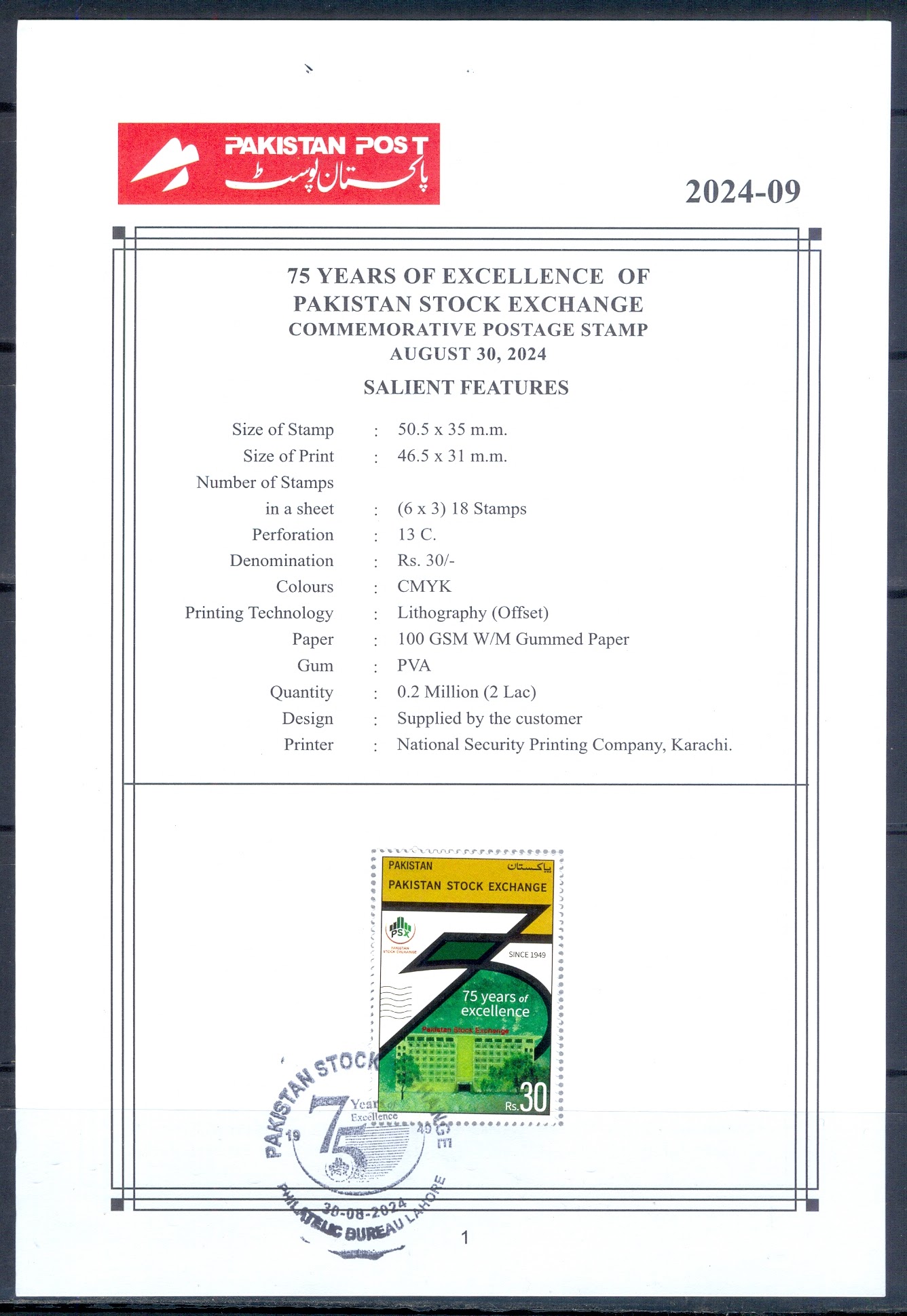
75 YEARS OF EXCELLENCE OF PAKISTAN STOCK EXCHANGE. AUGUST 30, 2024 (2024-9)


Pakistan Stock Exchange (PSX) is the national stock exchange of Pakistan. It was established with the name of Karachi Stock Exchange (KSE) on September 18, 1947. It was incorporated on March 10, 1949, under the name of Karachi Stock Exchange. (Guarantee) Limited as a company limited by Guarantee. In October 1970, a second stock exchange was established in Lahore by the name of Lahore Stock Exchange (LSE) to meet the stock trading or investment and listing needs of the provincial metropolis of Lahore and its surrounding region. In October 1989, a third stock exchange was established in Islamabad by the name of Islamabad Stock Exchange (ISE) to cater to the investors and companies of the northern parts of the country.

Originally, KSE was a small bourse having only five listed companies with a total paid- up capital of Rs 37 Million. As the years passed and more companies got listed, the first index constituting the companies on the bourse was formed. It was called the KSE 50 Index. Gradually, as the number of listed companies and trading activity increased, the need for a truly representative index was felt and the KSE 100 Index was formed on November 1, 1991. Other indices such as the KSE 30 Index and KMI 30 Index along with the recently added sectoral & ETF indices were also added, thus bringing a total of 16 indices on the Stock Exchange at present.

In the earlier days, trading of shares used to take place through open outery on the trading floor. This was a traditional way of communication between stockbrokers where verbal communication and hand signals were used for conducting transactions. One stockbroker would communicate that he was interested to buy a stock while another stockbroker would communicate that he was interested in selling a stock. Hence a buy sell deal was made across the trading pit. The open outcry method was eventually replaced in 2002 by the electronic trading system. The Karachi Automated Trading System (KATS) became operational at the Stock Exchange which was a robust, high performance and high-capacity trading system. This was later replaced by the New Trading & Surveillance System (NTS), a cutting edge, future-ready, and robust trading system, which was successfully implemented, installed and adopted in 2023.

The three stock exchanges, Karachi, Lahore & Islamabad stock exchanges had separate management, trading interfaces, indices and no mutualized structure. In March 2012, the Stock Exchanges (Corporatization, Demutualization, and Integration) Act 2012 was passed by the Parliament of Pakistan and in the month of May of the same year, it was signed by the President of Pakistan. By virtue of the said Act, all three stock exchanges were converted into companies limited by shares and it resulted into separation of ownership rights with the trading rights. The brokers were termed as initial shareholders who were issued shares of respective stock exchanges together with Trading Right Entitlement Certificates (TRECs). The said Act also required all the stock exchanges to divest 40% of their equity to strategic anchor investors and 20% to general public.

In order to implement the condition of divestment of shares laid down in theabove-referred Act in letter and spirit, it was essential to have only one stock exchange available for this purpose to the potential investors. As such, the operations of all three stock exchanges were ultimately integrated and a single entity with the name of Pakistan Stock Exchange Limited (PSX) emerged on January 11, 2016. It was followed by sale of 40% equity stake of PSX to Chinese consortium in the end of 2016 and offer of 20% equity stake to general public and self-listing of PSX in June, 2017. As such, PSX is now a commercial entity as well as an active frontline regulator of the capital market.

Many developments have taken place at PSX over the last few years. These include upgradation of PSX technology platform wherein a new Trading & Surveillance System has been implemented at the Exchange as mentioned earlier. Furthermore, the Exchange has brought forth new technological innovations and conventional developments such as the Online Account which allows investors to open an account digitally, the Sahulat Account which requires a simplified and convenient account opening process, the PSX WhatsApp Service to make available a host of information to users on their finger-tips, the My Portfolio virtual trading platform to enable users to learn the ropes of investing through real time trading but with virtual cash, the PSX Knowledge Center which is a repository of articles, blogs and financial calculators related to the capital markets, and the PSX Glossary which consists of a list of 500 terms and definitions to enhance and increase knowledge on the financial markets. Over the past few years, nine Exchange Traded Funds have also been launched at the Exchange. These ETFs belong to different categories such as those of equity, debt and Islamic. Moreover, PSX caters to those investors as well who are inclined towards Shariah compliant investments. In this context, PSX lists 258 Shariah-compliant companies amongst its listings.

The ecosystem of the Capital Market of Pakistan comprises of different parts which together enable the working of the Market as a whole. The companies at the forefront with PSX in the ecosystem of the Capital Market of Pakistan are Central Depository Company of Pakistan (CDC) and National Clearing Company of Pakistan Limited (NCCPL). CDC handles the transfer of shares traded and keeps the custody of shares held by investors electronically while NCCPL provides clearing and settlement services of shares and funds against the transactions conducted at the Exchange. The apex regulator is the Securities & Exchange Commission of Pakistan (SECP) under whose regulations, PSX operates. The securities brokers, capital market intermediaries, and the Asset Management Companies (AMCs) are an essential part of the capital market ecosystem as well.

Pakistan Stock Exchange lists 523 companies on the Main Board and 3 companies on the GEM Board, representing 36 industrial sectors having total market cap of over Rs9,947 trillion. In recent past, PSX outperformed the stock markets of the world and was called the world's second-best stock market by Bloomberg in October 2023. PSX was also the proud winner of Best Islamic Stock Exchange Award for three consecutive years, 2021, 2022, 2023, presented by Global Islamic Finance Awards (GIFA).

Pakistan Stock Exchange plays a crucial role in the country's economy as it channels domestic savings and foreign capital to the financial coffers of the country. By attracting interest from local and foreign investors, much needed capital inflows are channeled in the country through PSX. There are more than 318,000 investors investing on the Exchange. Pakistan Stock Exchange provides for an attractive avenue of investments with Price to Earning Ratio of 3.80 which is the lowest in the region. This is a clear reflection of the attractive valuation of stock prices prevalent at PSX. Not only that, Pakistan Stock Exchange has provided the highest Dividend Yield of 9.38%as compared to other markets of the region.

Not only for investors, but also for companies, PSX is an attractive capital market. By listing on the Stock Exchange, companies can obtain much needed financing to fund their growth, invest in new projects, and increase the country's exports. Companies listed on the Exchange provide employment and benefits to thousands of Pakistanis and their families and generate significant tax income for the Government of Pakistan.

On the occasion of completion of 75 Years of operations of Pakistan Stock Exchange, a Commemorative Postage Stamp of Rs. 30/- denomination is being issued by Pakistan Post on 30th August 2024.

Thursday, August 22, 2024

75TH ANNIVERSARY OF ESTABLISHMENT OF DIPLOMATIC RELATIONS BETWEEN PAKISTAN AND EGYPT. AUGUST 21, 2024 (2024-8)


Pakistan and Egypt have close fraternal relations, which are characterized by common bonds of faith, cultural affinities, and values between the people of two countries. Egypt was among the first countries to recognize Pakistan and the two countries exchanged resident Ambassadors in 1948. The relations between the two countries have strengthened more and more. Pakistan and Egypt have bilateral relations in the political, economic, trade, investment, education, cultural and defence fields. The two brotherly countries are celebrating 75th Anniversary of establishment of diplomatic relations.

2. Pakistan and Egypt are the promising developing economies with thriving young population. Both countries have economic and infrastructure development as the central agenda moving forward. They continue to highlight Islamic traditions and crafts in their modern infrastructure.

3. Islamabad is the new national capital of Pakistan, that was built in 1960s to replace Karachi as a capital. It is located on Pothohar Plateau of the northern Punjab region. As per the latest census in 2023, Islamabad Capital Territory has a population of 2.36 million. Islamabad is a lush green city with healthy climate. It is a modern and carefully planned city with wide roads and avenues, elegant public buildings and well-organized markets, and shopping centres. The metropolitan area of the city is divided into eight basic zones: Administrative, diplomatic enclave, residential areas, educational sectors, industrial sectors, commercial areas, and rural and green areas. Islamabad is a symbol of modern state representing vibrant and progressing nation of Pakistan.

4. Located on the foothills of Margalla hills, Islamabad has a scenic mosque in its centre with the name of Faisal Mosque. The mosque was built in the name of Saudi King Faisal Bin Abdul Aziz. Sprawling on 33 acres, it is now the sixth largest mosque in the world. The construction started in 1976 and the mosque was completed in 1986. Faisal Mosque was designed by Turkish Architect, Mr. Vedat Dalokay. It has unique and unconventional architecture. The main 8-sided hall of the mosque was designed in a way that it looks like a Bedouin desert tent. It has four minarets. It has the capacity to host 300,000 people for prayers.

5. To fulfil the increasing administrative needs and to accommodate the rising population of Cairo city, the Egyptian government has undertaken massive infrastructure project of building a new area, currently named as The New Administrative Capital (NAC). It is planned to be Egypt's new capital and has been under construction since 2015. NAC is a part of Egypt's agenda for economic development and larger initiative called 'Egypt Vision 2030'. The new city is located 45 kilometres (28 miles) east of Cairo and just outside the Second Greater Cairo Ring Road. Sprawling over 700 km², the city is expected to house a population of 7 million people. The city is planned to consist of a government administrative district, a diplomatic area, a cultural district (opera and theatres), a central business district (CBD), parks (the 'green river'), and 21 residential districts. The NAC would be completed in phases. Egyptian government has already started shifting government ministries to the New Administrative Capital in 2023.

6. To symbolize the modern architecture and Islam as basic essence, Egypt built a spectacular mosque in its New Administrative Capital, named Al-Fattah Al-Aleem Mosque. The mosque is located on the New Middle Ring Road in the New Capital. Al-Fattah Al- Aleem Mosque has been built on the allocated area of 110 acres and is considered one of the mega mosques in the world. Like Faisal Mosque in Islamabad, Al-Aleem Mosque is the hallmark of the development of New Administrative Capital in Egypt. It was inaugurated by Egyptian President Mr. Abdel Fattah el-Sisi in January 2019. The mosque has 21 domes and four minarets each of nearly 95 m in height. and is considered the 2nd biggest mosque in the world in terms of total area. Currently, the mosque has a capacity to house 17,000 people for prayers. The mosque also includes two Quran memorization houses one each for boys and girls.

On the 75th Anniversary of establishment of diplomatic relations between Pakistan and Egypt, the commemorative postage stamp is being issued by Pakistan Post of the value of Rs. 75/- each denomination on 21st August, 2024.

Friday, August 16, 2024

CELEBRATING 77 YEARS OF INDEPENDENCE HONOURING ARSHAD NADEEM'S ACHIEVEMENT. AUGUST 14, 2024 (2024-7)


On Pakistan's 78th Independence Day, we proudly introduce a special postal stamp that celebrates the remarkable achievement of Arshad Nadeem. Arshad Nadeem made history at the 2024 Paris Olympics by setting a new Olympic record with a phenomenal throw of 92.97 meters in the men's javelin throw final on August 8, 2024. Arshad Nadeem's gold medal stands as a profound symbol of national pride. This remarkable victory is not just a personal success but highlights the exceptional talent and potential of Pakistan's young athletes. His achievement reflects the dedication, skill, and determination needed to excel at the highest levels of international sport.

The new stamp commemorates Arshad Nadeem's outstanding performance and his contribution to bringing recognition to Pakistan on the global stage. His success story is an example of the remarkable achievements. possible through hard work and perseverance, inspiring future generations to pursue their own goals with the same dedication and hard work.

As we celebrate our 77 years of independence, this stamp honours Arshad Nadeem's incredible achievement and the broader promise of Pakistani talent. It's a moment to reflect on the pride we feel for Arshad Nadeem and the potential that continues to grow within our nation.

On the occasion of 78th Independence Day of Pakistan, a Special Postage Stamp of Rs. 100/- denomination is being issued by Pakistan Post on August 14th, 2024,

Monday, August 12, 2024

GOLDEN JUBILEE CELEBRATIONS OF THE ALLAMA IQBAL OPEN UNIVERSITY (1974-2024) JULY 23, 2024 (2024-6)


Allama Iqbal Open University (AIOU) is a Public Sector University of Pakistan with over 1 Million students on its roll and is the second largest Open University in Asia. The University is entrusted with the responsibility of imparting education to all the strata's of society and is operating in all the provinces of Pakistan.

AIOU is a prominent institution of distance education established in 1974. The university is named after Allama Muhammad Iqbal, a renowned philosopher, poet, and politician who played a pivotal role in the creation of Pakistan, AIOU is the first open niversity in Asia and one of the largest distance learning institutions in the world.

AIOU aims to provide accessible and affordable education to a diverse population, catering to the needs of individuals who are unable to attend conventional brick-and-mortar institutions due to various reasons such as geographical constraints, work commitments, or financial limitations. The university has played a crucial rote in expanding educational opportunities across Pakistan and beyond.

One of the distinctive features of AIOU is its commitment to inclusive education. It offers a wide range of academic programs, including undergraduate, postgraduate, and doctoral degrees, as well as diplomas and certificates in various disciplines. The diverse academic offerings encompass fields such as humanities, social sciences, natural sciences, business administration, and technical and vocational education.

AIOU operates on a semester system, providing flexibility for students to pursue their education

at their own pace. The university employs a comprehensive and innovative approach to distance learning. Incorporating printed course materials, multimedia resources, and online platforms to facilitate effective learning. The use of modern technology enables students to access study materials, submit assignments, and interact with instructors and fellow students from the comfort of their homes.

The university's commitment to reaching underserved population is evident in its extensive network of regional and sub-regional offices across Pakistan. These offices serve as support centers, offering assistance to students and facilitating the delivery of study materials. AIOU's reach extends beyond national borders, as it has attracted students from various countries, contributing to the internationalization of the institution.

Through the massive technological intervention and the integrated automated suites of

applications like CMS (Campus Management Solution), EPB (Enterprise Planning &Budgeting), ERP (Enterprise Resource Planning) and LMS (Learning Management System) that has enabled the students to have an improved learning experience in addition to pursuing their academic activities at their choice of time and place, besides they can also refer back to the recorded lectures available in LMS and can benefit while being off-line also. The tutoring to the students of AIOU is being provided by the quality academicians from various institutions across Pakistan.

In addition to academic pursuits, AIOU is actively involved in community development initiatives. The university collaborates with government agencies, non-profit organizations, and community groups to implement projects that address social issues, promote literacy, and enhance the quality of life for marginalized populations.

The commitment to lifelong learning is a key aspect of AIOU's philosophy, The university encourages continuous education and skill development by offering a variety of short-term courses, workshops, and training programs to meet the evolving needs of the workforce. For timely transmission and delivery of the study material and other important correspondence of the University to the enrolled students throughout country especially in far flung area, the role of Pakistan Post cannot be denied. Pakistan Post being a trusted partner has played a vital role not only in providing delivery service since the establishment of the University but also established a post office a complete Sorting Section and a complaint cell for full facilitation of the university and students. in the premises of the University.

AIOUis the largest university of Pakistan in terms of Students' enrollment and educational programmes. It is apprised that around 5 million students have graduated from the University since its enactment and are contributing to the development of motherland. The university in its Convocation recognize student achievements and confer upon them publicly the degrees. earned by them through dedication and hard work.

In conclusion, Allama Iqbal Open University stands as a beacon of accessible education, providing a platform for individuals to overcome barriers and pursue academic and professional goals. Its innovative approach to distance learning, commitment to inclusivity, and dedication. to research and community development contribute to its significance in the realm of education in Pakistan and beyond. As a trailblazer in open and distance learning, AIOU continues to play a crucial role in shaping the educational landscape and empowering individuals to achieve their full potential.

Design elements of Commemorative Postage Stamps and Souvenir Sheet.

These stamps are South Asia's first and Asia's second Artificial intelligence assisted postage stamps.

All stamps are set in turquoise color which symbolizes wisdom. The stamps shows dedicated students and the main campus of university,

* Souvenir Sheet encompasses all the previous issues of Pakistan Post to commemorate AIOU along with above four stamps. In the backdrop is the imposing building of Main Hall of AIOU at Islamabad campus.

On the occasion of the Golden Jubilee Celebrations of the Allama Iqbal Open University Islamabad, the Commemorative Postage Stamps Rs.30/-denomination (Set of 4) and a Souvenir Sheet with the Value of Rs.100/-are being issued by Pakistan Post on July 23rd, 2024.