Saturday, October 12, 2024

150th Anniversary of UPU, celebration event held at GPO Multan

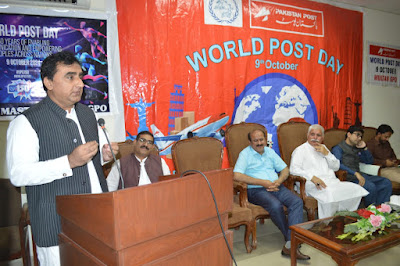
Multan; Commissioner Multan Madam Maryam Khan, Postmaster General Zaheer Ullah Khattak, Deputy Postmaster General Rai Saifullah, Educationist Prof. Dr. Hameed Raza Siddiqui, Chief Postmaster Arif Khan Niazi were present at the event held at Multan GPO on the occasion of World Post Day. Senior stamp Collector Tayyab Ehsan and other important personalities addressed the event.

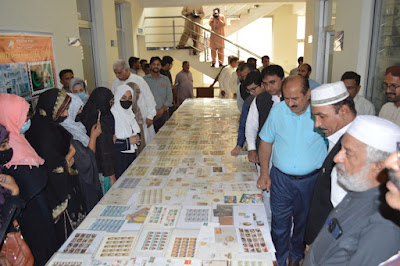
After the ceremony, Commissioner Multan Maryam Khan also inaugurated the exhibition of commemorative stamps.

Postmaster General South Punjab Zaheer Ullah Khattak during his speech on the event
Commissioner Multan Madam Maryam Khan during her speech on the event
Cake cutting ceremony for the 150th Anniversary of UPU
Commissioner Multan and Postmaster General at the commencement of stamps show
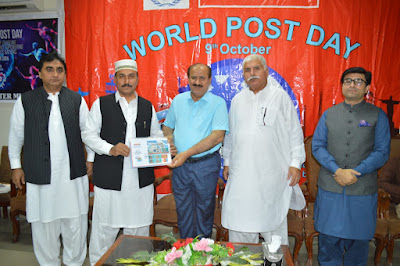
Tayyab Ehsan presenting Commissioner Multan with stamps gift
Group photo of the participants


150th Anniversary of UPU, celebration event held at Allama Iqbal Open University Multan Campus

Multan; On the occasion of World Post Day, Stamps Seminar was organized by Multan GPO and Multan Stamp Society at Allama Iqbal Open University Multan Campus.

Deputy Postmaster General Rai Saifullah, Ghulam Hussain Khosa Regional Director Allama Iqbal University, Chief Postmaster Arif Khan Niazi, Divisional Superintendent Abu Bakr, Manager Express Post Ishaq Baloch were the chief guests in the ceremony. Senior Postmaster Shahid Yusuf, Senior Stamp Collector Tayyab Ehsan, and other postal staff.

Deputy Postmaster General Rai Saifullah during his speech on the event

Sunday, October 6, 2024

50TH ANNIVERSARY OF TARBELA DAM. October 1st, 2024 (2024-10)


Year 2024 marks a momentous occasion for development of water and hydropower resources in Pakistan, as the iconic Tarbela Dam turns 50 this year. After completion of the civil works of Tarbela Dam by WAPDA in third quarter of 1974, filling of water in the reservoir commenced 50 years ago.

Tarbela Dam stands as a symbol of national pride over the last five decades. Tarbela is the capstone of the Indus Basin Plan to ensure the continued and improved supply of water to millions of acres of irrigated land in Pakistan, mitigate floods and generate green, clean and most affordable hydroelectricity to move wheel of the national economy.

Tarbela Dam Project has been playing an instrumental role for economic development and social uplift in Pakistan during the last 50 years. The contribution Tarbela Dam Project has made towards progress in the country can be judged from the fact that it has released 406-million-acre feet (MAF) of stored water from the reservoir for agriculture and contributed 590,361 million units of low-cost and environment friendly hydel electricity to the National Grid. It is important to note that the economic and financial benefits of one MAF of water in Pakistan are estimated at US$ 1,000 million (US$ 1 billion). Therefore, total benefits accrued from Tarbela Dam during the last 50 years stand at US$ 406 billion.

Tarbela Dam, the largest earth and rock-fill dam in the world at the time of its completion, is located across River Indus 64 Km north-west of Islamabad. The construction work on Tarbela Dam commenced in 1968, while all the civil workscompleted in 1974. Development of powerhouses commenced in phases starting from 1974 onwards.

Tarbela Dam Project consists of a 9,000 feet (2,743 meters) long and 470 feet (143 meters) high embankment across the entire width of the river. It has two spillways with cumulative discharge capacity of 1,500,000 cusecs (42,476 cumeces). Two auxiliary embankment dams close the low- level ridges in the left bank valley. A group of 4 tunnels, each 0.8 Km long through the right abutment, were constructed for irrigation releases and power generation.

Tarbela reservoir which spans over an area of 259 square Km, had initially a live storage of 9.68 MAF. However, it has reduced to 5.77 MAF due to natural phenomenon of sedimentation during the last 50 years.

A power station on the right bank near the toe of main dam houses 17 power units at Tunnels 1, 2,3 and 4. Tarbela is the biggest electricity generation facility in Pakistan with installed capacity of 4888 MW51.6% of the total hydel capacity of WAPDA. The installed capacity at Tarbela will further increase to 6418 MW after completion of the under- construction Tarbela 5th Extension Hydropower Project.

Cost of Tarbela Dam Project including power units 1 to 14 amounts to US $ 2,630 million. Cost of Tarbela 4th Extension Hydropower Project with power units 15 to 17 stands at US$ 1,075 million, while that of under-construction Tarbela 5th Extension, with power units 18 to 20, is estimated at US $ 807 million.

To mark 50 years completion of Tarbela Dam, the Commemorative Postage Stamp of Rs.50/-denomination is being issue by Pakistan Post on October 1st, 2024.

Wednesday, September 25, 2024

Convention On The Rights Of The Child Decade Celebration. 1999-17)


Every society hopes and expects that its children will grow up to be capable and responsible citizens who contribute to the well being of their communities. Yet, around the world children are denied the rights that would enable them to survive, develop fully and participate actively.

Children whose basic needs and fundamental rights are denied can not be expected to mature into caring, productive adults who will respect the rights of others. Violations of rights are not only the cause of personal suffering, they also sow the seeds for political and social unrest, even for violent conflicts.

For the sake of both individual and global development, children around the world need to understand the concept of rights.

WHAT IS THE CONVENTION ON THE RIGHTS OF THE CHILD

The convention on the rights of the child is a United Nations agreement that spells out the range of rights that children everywhere are entitled to. This convention is the first Universal legally binding code of Child Rights in history. It brings together in one treaty all the relevant Child Rights issues, rather than having them scattered in a number of international treaties. Countries that ratify the convention (thereby becoming “State Parties” to it) agree to be legally bound by its provisions.

The Convention on the Rights of the Child contains 54 articles, each of which details a different type of Right.

Four broad categories of the document are as follows.

1. Survival Rights

2. Development Rights

3. Protection Rights

4. Participation Rights

HOW DID THE CONVENTION ON THE RIGHTS OF THE CHILD COME ABOUT?

In 1948 the United Nations General Assembly adopted a Universal Declaration of Human Rights. This document includes Children’s Rights.

In 1959, a declaration of the Rights of the Child was adopted by the United Nations. It consisted of 10 rights, and was not a legal binding on the countries that signed it. In 1978, a draft convention on Children’s Rights was submitted to the United Nations Commission on Human Rights by the Government of Poland.

During the International Year of the Child in1979, the Commission set up a working group to coordinate the range of ideas on the draft convention being submitted by governments around the world.

On 20 November 1989, the Convention on the Rights of the Child was completed and adopted by the General Assembly. The convention entered into force in 1990, after being ratified by 20 countries.

As of 1 December 1993,153 countries have demonstrated their commitment to the future of their children by ratifying the convention on the Rights of the Child.

CHILDREN’S RIGHTS AND PARENTS

While the Convention on the Rights of the Child upholds a number of basic rights, it dose not in fringe on the rights of parents to decide what is best for their children. Instead it specifically states that government shall make every effort to keep families intact, and shall provide support and assistance to parents in fulfilling their primary responsibilities with regard to the upbringing and development of their children.

The promotion of Children’s Rights is not a matter of placing children in conflict with adult authorities in their lives, but of encouraging all citizens to work together for a safe, healthy and productive future for children.

To commemorate the occasion Pakistan Post Office is issuing a commemorative postage stamp of Rs 2 denomination on November 20, 1999.

100 Years Of Shell In Pakistan. 1999-16)

The energy sector is of vital significance to a developing country like Pakistan as both agriculture and industry are highly dependent on energy to fuel growth. Moreover, with a rapidly increasing population, greater urbanization and high rates of economic growth, energy demand seems set to rise by 6-8 percent a year.

As one of the largest investors in the energy sector Shell plays a vital role in the country’s economic uplift by enhancing the quality of products and services as well as improving the distribution infrastructure. Shell also plays a role in the exploration for oil and gas which helps reduce dependence on imports.

Shell has a strong brand name with a 100-year history in this region. In 1899, the Company began by importing kerosene from Azerbaijan probably as a fuel for lamps - in fact the Company is still in possession of a fuel storage tank from that period.

In 1928, from Asiatic Petroleum, the name of the Company changed to the Burmah Shell Oil Storage and Distribution Company of India when the marketing interests of the Royal Dutch Shell Group and the Burmah Oil Company in India merged.

After the independence of Pakistan in 1947, the name was changed to the Burmah Shell Oil Distribution Company of Pakistan. In 1970 Burmah Shell divested 51 percent to the public and became a listed company renamed Pakistan Burmah Shell (PBS), with Burmah Oil and Shell retaining 24.5 percent stakes each.

Finally, in early 1993, Shell acquired Burmah Oil’s holdings along with an additional 2 percent purchased in the market to obtain majority share-holding of the company which was renamed Shell Pakistan Limited (SPL) a partnership between Pakistani and foreign investors.

But the story does not end here. As an energy company committed to sustainable development, Shell has been active in both upstream (exploration) and downstream projects (refining, blending, distribution and marketing) to contribute to fulfilling Pakistan’s energy requirements.

To this end the Royal Dutch Shell Group has interests in three other companies in Pakistan; 100 percent share-holding of Shell Development and Offshore Pakistan B.V, 67 percent stake in Burshane (Pakistan) Limited and 30 percent stake in Pakistan Refinery Limited.

SHELL IN PAKISTAN TODAY

With annual sales approaching US $ 1 billion, Shell Pakistan is one of the leading private sector companies in Pakistan. The Company has achieved rapid growth in recent years through a vigorous capital investment programme and by ensuring international standards of service and product quality.

However investment is not limited to infrastructure alone - Shell Pakistan prides itself on its investment in people; not merely through job creation but also through training and the build up of experience and skills. This commitment covers the whole spectrum of our people, whether we are developing the business leaders of tomorrow or teaching our pump attendants basic literacy. Shell Pakistan provides employment directly or indirectly to over 12,000 persons in Pakistan.

SPL is one of the highest corporate tax payers having paid Rs. 1.5 billion to the exchequer and collected Rs 87 billion in government duties during 1993-1999 alone. Sales volumes and profitability continue to grow with the Company announcing a record divided of 125 percent for the year 1998/1999.

As a major oil marketer, Shell currently holds about 22 percent share of the hydro-carbon business in Pakistan. In addition to its products, the Company is supplying value added services in long term relationships to industries and businesses including cement, sugar, textiles, airlines, railways, ports, road transport, construction etc.

The retail network of over 1100 petrol pumps is the flag bearer of the business. Shell sells a range of products including Motor Gasoline, High Speed Diesel and lubricants from its Retail Sites built to the highest international standards. Shell has demonstrated market leadership by providing the best to its customers in terms of physical facilities and customer value propositions which others strive to emulate.

Shell takes pride in being a responsible corporate citizen having contributed over Rs. 30 million to the Pakistani community through its social investment programme during the past 6 years.

Through this programme Shelf has had and continues to maintain relationships with a number of non-governmental organisations working in the areas of community welfare, health, education, heritage and the environment.

After all Shelf sees its role as not just that of a commercial operator, but as part of the community and society of which it is an integral part. The aspirations of the people of Pakistan are Shell’s aspirations as well and it will continue helping those people build a better world.

Shell is working hard toward the economic development of the country by participating in and actively advocating Pakistan’s investment possibilities at home and overseas. In this regard it has invested heavily and consistently in the region for over a hundred. Shell has been active at all economic forums including the Overseas Chamber of Commerce and Industry of which it was the Chairman and has worked closely with the government in formulating and advising on policy.

It has received several awards for high performance including the Top Companies Award presented by The Karachi Stock Exchange in 1997, 1994 and 1993. Shell’s commitment to the country’s economic and social development remains unequivocal and it hopes to see a prosperous Pakistan moving ever faster on the road of development.

AFTER ALL ‘YOU CAN BE SURE OF SHELL’

To commemorate the occasion Pakistan Post Office is issuing a commemorative postage stamp of Rs 4 denomination on November 15,1999.