Wednesday, September 25, 2024

10th Asian Optimist Sailing Championship. (1999-12)


The first Optimist was built in 1948 and was soon a popular youth boat in and around Clearwater and St. Petersburg. For some time, it was only known in that area.

The turning point for the Optimist class came in 1954 when Axel Damagaard, skipper of a Danish three masted tall ship, saw an Optimist while his ship was visiting the United States. When he returned to Denmark Axel promoted the design.

The Optimist soon became very popular throughout Scandinavia where it was renamed the International Optimist Dinghy-its official name today.

The IDA spread throughout Europe in the 1960’s. In 1962, the first World Championship were held, at Humble in the UK in 1965, seven nations got together and formed the IODA (International Optimist Dinghy Association).

In 1973, the class received International status from the sailing world’s governing body, the International Yacht Racing Union (now ISAF). During the 1 970s the popularity of the Optimist spread to Asia, Africa and Latin America.

Today, the Optimist is the World’s largest and fastest growing-sailing class, bigger than lasers, Hobbies, Sunfish, or any other One-design. While many boats Claim “International” in their title, there is none which is sailed in more countries. The Optimist may be the World’s only true “International” Dinghy.

The International Optimist is the only dinghy recognised by International Sailing Federation for young people under 16 years of age. It is sailed by over 200,000 people worldwide, including most future competitors at the Olympic Games.

The 10th Asian Championship in Karachi is an important contribution to the rapid development of the Optimist in Asia. In 1998 Asian sailors won their first ever medals at the World Championship, winning gold, silver and bronze.

Both the two previous Optimist philatelic issues, in 1995 (Aaland Islands, Finland) and 1997 (United Kingdom), were a great success.

In Pakistan, 10th Asian Optimist Sailing Championship is being held from 30th September to 7th October, 99 at marina Club Karachi.

Courtesy: Pakistan Optimist Sailing Association (POSA).

To commemorate the occasion Pakistan Post Office is issuing one commemorative postage stamp of Rs 2 denomination on October 7,1999.

Monday, September 23, 2024

9th Asian Sailing Championship. (1999-11)


As early as 1980 Asian countries planned to have regional sailing championships. Initially these championships were called Asian Regattas. To make common public understand the sailing was added instead of Regatta. As per the rules of Asian Sailing Championship it is held every alternate year.

Pakistan sailors have dominated in Enterprise class ever since 1978 when they won the first Gold medal. Later our sailors also excelled in other classes too.

It is interesting to note that 5 major international classes are extensively sailed in Pakistan and these are Enterprise, 470, Laser, Mistral and Optimist, Each boat is different from other and although basics are same, however, while racing each boat requires different expertise and handling. A brief detail is enumerated below.

a) ENTERPRISE It is a British design boat which is famous for having Blue sails. Two persons are required to sail the boat. In Pakistan since our sailors have won 4 Gold and 2 Silver Medals in last 6 consecutive Asian Games, the class is very popular and has attained a status of National class.

b) 470A French boat which is 470CM long. It has 3 sails and require 2 persons to sail it. It is an Olympic class as well and come in the category of High performance dinghy. In Pakistan many clubs are Using this boat for experienced sailors.

c) LASER Laser is a single handed boat, It is also a British boat and requires a strong person to as it is very tough to handle during in strong breeze. Laser is also an Olympic class and in Pakistan it is very popular class. Pakistani sailors have participated in this class in many Asian Championships.

d) MISTRAL Yet another Olympic class which is extremely difficult to handle. The boat comes under the category of surfing boards. In Pakistan this class is quite popular and competed at National and International level.

e) OPTIMIST A pram of sailing which is an international boat and the most popular class amongst children. The class was started as early as 1988 by Pakistan Sailing Federation and soon due to its popularity it has gained a Status that no club is complete without Optimist. This is a boat for children under 15 years of age. In addition to Asian, Games Optimist boat is also sailed in regional and World Championships.

In Pakistan, Asian Championship is being held from 24 - 30 September at Beach View Club, Karachi. This is the 9th issue of Asian event which is the biggest sailing event in the history of Pakistan. The previous history is as under.

1st - 1981 - India

2nd - 1983 - Japan

3rd - 1985 - South Korea

4th - 1987 - Indonesia

5th - 1989 - China

6th - 1991 - Hong Kong

7th - 1983 - Japan

8th - 1995 - Singapore

9th - 1999 - Pakistan

The 9th issue was originally scheduled in 1997 in Thailand, which could not be held it.

Therefore now Pakistan is hosting this mega sailing event. Pakistan made this bid in 1996 during AYF meeting held and was formally confirmed last year on 11 Dec 98 during AYF meeting at Thailand.

Courtesy: Pakistan Sailing Federation.

To commemorate the occasion Pakistan Post Office is issuing a set of 5 commemorative postage stamps of Rs 2 denomination each on September 28,1999.

Friday, September 6, 2024

Golden Jubilee Celebrations Of The Founding Of The People's Republic Of China. (1999-10)


The year 1999 is the 50th anniversary of the founding of the People’s Republic of China (1 949-1999). This event is all the more important for the Chinese nation as the whole mankind is on the verge of entering the 21st century.

People’s Republic of China appeared on the map of the world on October 1, 1949, which was the culmination of the glorious struggle of the Chinese people started from the democratic Revolution of 1911 led by Dr. Sun Yat Sen who inspired the resurgence of China.

The Chinese people suffered greatly for more than a century but they never compromised with the status quo and relentlessly struggled against the forces of exploitation. Eventually, they came out victorious under the dynamic leadership of Mao Zedong.

On October 1, 1949, some 300,000 people gathered at the Tian’anmen square in Beijing and Mao Zedong, Chairman of the Central People’s Government proclaimed the founding of the People’s Republic of China.

The national flag of China is red in colour which symbolizes Revolution, the five stars on the flag symbolize the unity of the Chinese people under the leadership of the communist party of china (CPC).

The national emblem of China is ‘Tian’ an men in the center illuminated by five stars and encircled by ears of grain and a cogwheel. Tian’anmen symbolizes the Chinese nation and the ears of grain and the cogwheel represent the working class and peasantry.

After the establishment of the People’s Republic of China, Mao Zedong and Chou En Lai played a vital role not only to strengthen the roots of the Communist Party of China but also to improve the economic lot of the Chinese people.

Chou En Lai was the chief architect of New China’s foreign policy and led the country with remarkable dexterity and talent, Henry Kissinger described Chou En Lai as “the greatest statesman of our era”.

He was a man of remarkable vision. After gaining for China its rightful place in the UN Security Council in 1971, Chou En Lai recorded yet an other major diplomatic success when in early 1972, he received US President Richard Nixon in Beijing.

The visit led to normalization of relations between China and the United States of America. In this historic reconciliation, Pakistan served as a bridge between the two great nations of the world.

After the death of Mao Zedong in 1976, Deng Xiao Ping guided the country and embarked upon a programme of modernization, with economic reconstruction as its priority task.

Deng Xiao Ping was the chief architect of China’s Reform and the opening up drive (1978) to the outside world. Today, the People’s Republic of China is an emerging economic giant in Asia.

Since 1980, China has established special economic zones in Guandong, Fujian and the province of Hainan. In 1984, China opened 14 coastal cities to overseas investment. In 1990, the Chinese government decided to open the Pudong New Zone in Shanghai to overseas investment, which has now become an international economic center.

On July 1,1997, People’s Republic of China resumed its sovereignty over Hong Kong and proclaimed it a Special Administrative Region under the principle of “ONE COUNTRY, TWO SYSTEMS”. People’s Republic of China will resume her sovereignty over Macao on 20th December 1999.

Pak-China friendship is unique in the history of the world. Pakistan was one of the first countries, which accorded recognition to People’s Republic of China. The government of Liaquat Au khan vigorously supported the cause of China in the United Nations.

Formal diplomatic relations between Pakistan and China were established on May21, 1951.

Pakistan and China have maintained extremely cordial relations during the last five decades.

China has always extended full co-operation to Pakistan in its developmental projects in agriculture, energy, industry, defence and tele-communications. This is considered a model relationship among two neighboring countries of the Third World.

With the rapidly growing closer relations between the two countries, the exchange of cultural and trade delegations has become more frequent. China fully supports Pakistan’s stand on Kashmir. Likewise, Pakistan has always subscribed to the idea of “One China” policy.

People’s Republic of China is destined to become more vigorous and achieve even greater successes in the next century. It is hoped that bilateral relations between Pakistan and China will further strengthen in the next millennium.

LONG LIVE PAK-CHINA FRIENDSHIP

To commemorate the Golden Jubilee celebrations Pakistan Post Office is issuing a set of 2 commemorative postage stamps of denomination of Rs 2 and Rs 15 on September 21, 1999.

Islamic Development Bank Twenty Five Years Of Devotion To The Islamic Ummah. (1999-9)


ESTABLISHMENT AND OBEJECTIVES

The Islamic Development Bank (1DB) is a multilateral International Islamic financial institution with 54 countries of the Organization of the Islamic Conference (010) as its members.

It provides a framework to fulfil aspirations of the Ummah for economic and financial cooperation among Muslim countries in a global environment characterized by economic blocks and regional groupings. The Bank was officially inaugurated on 20th October 1975. Its Head Office is at Jeddah, Saudi Arabia.

MISSION AND CHALLENGES

During the last 25 years, the Bank made sustained efforts for developing its capacity in Islamic financial and economic practice. It is making significant contribution for enhancing economic and social development in member countries.

As a long term policy, it is helping the Muslim countries in facing the challenge of different global currents through direct trade channels and technical cooperation programmes. But it stands out quite distinctly from other financial institutions as it performs all its activities in the framework of the Islamic Shariah.

ACHIEVEMENTS

The Bank has devised a number of financing modes based on the Islamic Shariah such as grants, interest-free loans, profit sharing, equity participation, leasing murabaha, installment sale, istisna’a, and technical assistance.

By June 1999, the Bank had financed about 3,000 operations for 53 member countries and 63 Muslim communities involving more than US $ 20 billion. The Bank extends financing not only for implementation but also for feasibility studies, engineering designs, consultancy for supervising projects in the form of grants and concessionaire loans.

In a bid to stimulate development in 21 least developed member countries, the Bank has set up a Special Account with a capital of US$ 150 million for those projects that cannot be financed through its ordinary operations.

MODES OF FINANCING

Islamic Development Bank is implementing its policies through following modes of financing. Import Trade Financing Operation.

The Bank started this scheme in 1977 for financing import trade operations of basic commodities and development oriented production equipments from member countries. The Bank has spent over US$ 11 billion, since its inception, on more than 925 financing operations under this Scheme involving 32 countries.

EXPORT FINANCING SCHEME

The Bank established this scheme in 1987 in order to finance export of consumer goods, semi-processed goods and non-traditional capital goods among member countries. The scope of market has now been expanded to include OECD countries. The repayment period extends normally from six to sixty months.

The mode of financing is usually modaraba. The scheme has its own membership capital. By the close of 1998, it had 23 members with a subscribed capital of Islamic Dinar (ID) 315 million. The Bank had approved operations worth ID 306 million under the scheme by then.

ISLAMIC BANKS’ PORTFOLIO

The Bank has managed this portfolio since 1987 in collaboration with 20 banks with a capital of US$ 65 million. The capital has now been increased to US$ 380 million. It is an investment pool which mobilizes available liquidity with the Islamic banks. The 1DB channels it for trade and leasing with special emphasis on private sector.

THE IDB UNIT INVESTMENT FUND

The 1DB launched this Fund in 1990, with an initial capital of US$ 100 million and then increased it to US$ 325 million by 1998. The Fund purchases leasing and installment sales projects financed by the Bank and thus re-finances its activities. In order to enhance its investment activities, the Fund also invests from its own account.

THE ISLAMIC CORPORATION FOR THE INSURANCE OF INVESTMENT AND EXPORT CREDIT

It is an independent institution affiliated with the 1DB. It commenced business in 1995 and by 1998, 34 countries of the OIC had signed its Articles of Agreement.

The Corporation issues insurance policies to cover capital invested in export trade. It has a capital of US$ 150 million. Twelve member countries had availed of the insurance facilities of this scheme till now.

SPECIAL ASSISTANCE TO MUSLIM COMMUNITIES IN NON-MEMBER COUNTRIES

The 1DB gives special attention to Muslim communities living in non-member countries. The Bank has so far provided US$170 million to over 285 educational and health projects in 63 Muslim Communities.

TECHNOLOGY TRANSFER

The Bank has also contributed towards technology transfer. In 1984, it set up a Special Technical Cooperation Programme in order to provide technical assistance to member countries for capacity building and exchange of information. In 1991, the Bank also set up a Special Scholarship Programme in science and technology for outstanding students.

The Bank is always striving to face the challenges of future. It is playing an active role in meeting development needs of its member countries.

To celebrate the Silver Jubilee of Islamic Development Bank, Pakistan Post Office is issuing a commemorative postage stamp of Rs 5 denomination on September 18, 1999.


Friday, August 30, 2024

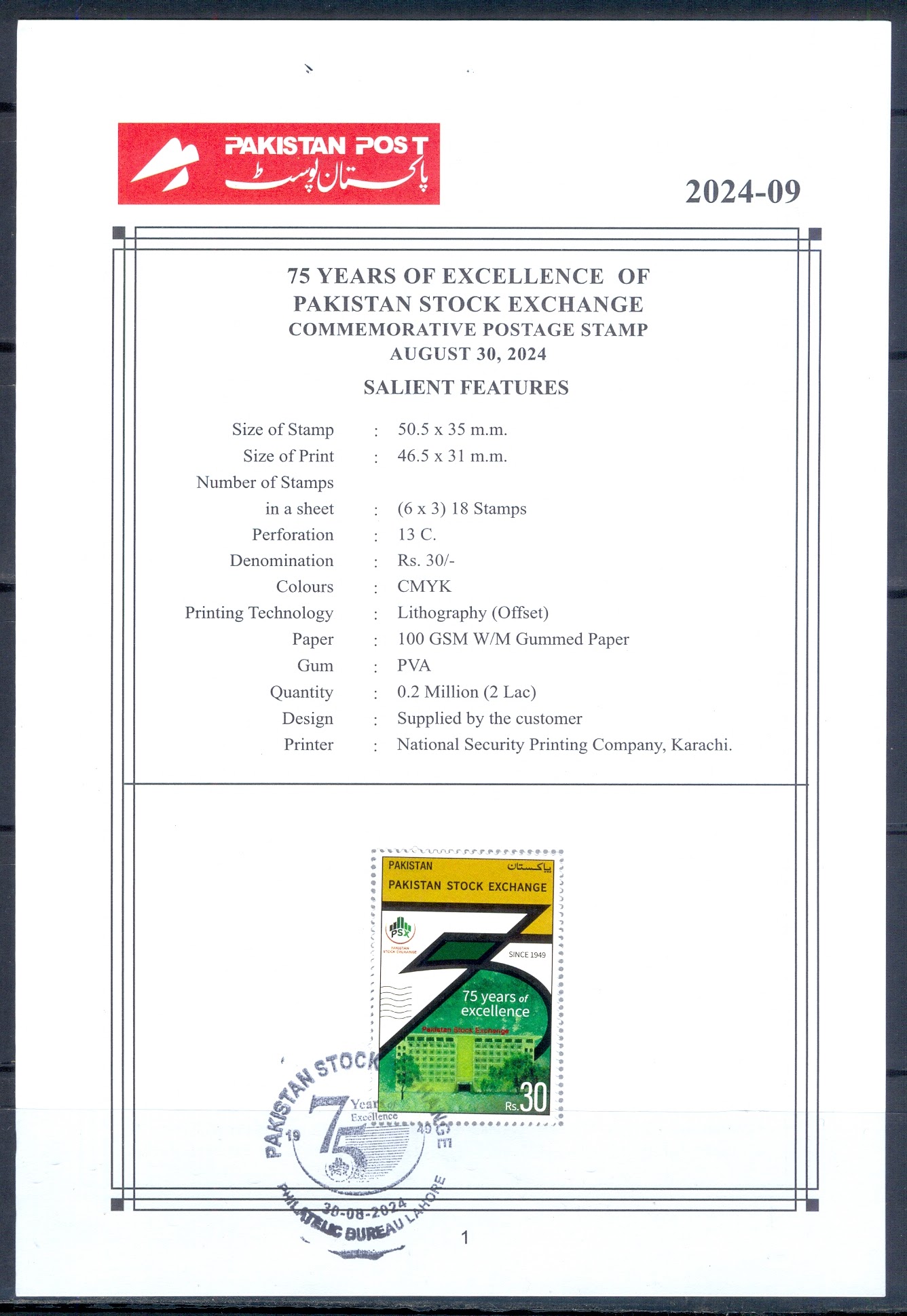
75 YEARS OF EXCELLENCE OF PAKISTAN STOCK EXCHANGE. AUGUST 30, 2024 (2024-9)


Pakistan Stock Exchange (PSX) is the national stock exchange of Pakistan. It was established with the name of Karachi Stock Exchange (KSE) on September 18, 1947. It was incorporated on March 10, 1949, under the name of Karachi Stock Exchange. (Guarantee) Limited as a company limited by Guarantee. In October 1970, a second stock exchange was established in Lahore by the name of Lahore Stock Exchange (LSE) to meet the stock trading or investment and listing needs of the provincial metropolis of Lahore and its surrounding region. In October 1989, a third stock exchange was established in Islamabad by the name of Islamabad Stock Exchange (ISE) to cater to the investors and companies of the northern parts of the country.

Originally, KSE was a small bourse having only five listed companies with a total paid- up capital of Rs 37 Million. As the years passed and more companies got listed, the first index constituting the companies on the bourse was formed. It was called the KSE 50 Index. Gradually, as the number of listed companies and trading activity increased, the need for a truly representative index was felt and the KSE 100 Index was formed on November 1, 1991. Other indices such as the KSE 30 Index and KMI 30 Index along with the recently added sectoral & ETF indices were also added, thus bringing a total of 16 indices on the Stock Exchange at present.

In the earlier days, trading of shares used to take place through open outery on the trading floor. This was a traditional way of communication between stockbrokers where verbal communication and hand signals were used for conducting transactions. One stockbroker would communicate that he was interested to buy a stock while another stockbroker would communicate that he was interested in selling a stock. Hence a buy sell deal was made across the trading pit. The open outcry method was eventually replaced in 2002 by the electronic trading system. The Karachi Automated Trading System (KATS) became operational at the Stock Exchange which was a robust, high performance and high-capacity trading system. This was later replaced by the New Trading & Surveillance System (NTS), a cutting edge, future-ready, and robust trading system, which was successfully implemented, installed and adopted in 2023.

The three stock exchanges, Karachi, Lahore & Islamabad stock exchanges had separate management, trading interfaces, indices and no mutualized structure. In March 2012, the Stock Exchanges (Corporatization, Demutualization, and Integration) Act 2012 was passed by the Parliament of Pakistan and in the month of May of the same year, it was signed by the President of Pakistan. By virtue of the said Act, all three stock exchanges were converted into companies limited by shares and it resulted into separation of ownership rights with the trading rights. The brokers were termed as initial shareholders who were issued shares of respective stock exchanges together with Trading Right Entitlement Certificates (TRECs). The said Act also required all the stock exchanges to divest 40% of their equity to strategic anchor investors and 20% to general public.

In order to implement the condition of divestment of shares laid down in theabove-referred Act in letter and spirit, it was essential to have only one stock exchange available for this purpose to the potential investors. As such, the operations of all three stock exchanges were ultimately integrated and a single entity with the name of Pakistan Stock Exchange Limited (PSX) emerged on January 11, 2016. It was followed by sale of 40% equity stake of PSX to Chinese consortium in the end of 2016 and offer of 20% equity stake to general public and self-listing of PSX in June, 2017. As such, PSX is now a commercial entity as well as an active frontline regulator of the capital market.

Many developments have taken place at PSX over the last few years. These include upgradation of PSX technology platform wherein a new Trading & Surveillance System has been implemented at the Exchange as mentioned earlier. Furthermore, the Exchange has brought forth new technological innovations and conventional developments such as the Online Account which allows investors to open an account digitally, the Sahulat Account which requires a simplified and convenient account opening process, the PSX WhatsApp Service to make available a host of information to users on their finger-tips, the My Portfolio virtual trading platform to enable users to learn the ropes of investing through real time trading but with virtual cash, the PSX Knowledge Center which is a repository of articles, blogs and financial calculators related to the capital markets, and the PSX Glossary which consists of a list of 500 terms and definitions to enhance and increase knowledge on the financial markets. Over the past few years, nine Exchange Traded Funds have also been launched at the Exchange. These ETFs belong to different categories such as those of equity, debt and Islamic. Moreover, PSX caters to those investors as well who are inclined towards Shariah compliant investments. In this context, PSX lists 258 Shariah-compliant companies amongst its listings.

The ecosystem of the Capital Market of Pakistan comprises of different parts which together enable the working of the Market as a whole. The companies at the forefront with PSX in the ecosystem of the Capital Market of Pakistan are Central Depository Company of Pakistan (CDC) and National Clearing Company of Pakistan Limited (NCCPL). CDC handles the transfer of shares traded and keeps the custody of shares held by investors electronically while NCCPL provides clearing and settlement services of shares and funds against the transactions conducted at the Exchange. The apex regulator is the Securities & Exchange Commission of Pakistan (SECP) under whose regulations, PSX operates. The securities brokers, capital market intermediaries, and the Asset Management Companies (AMCs) are an essential part of the capital market ecosystem as well.

Pakistan Stock Exchange lists 523 companies on the Main Board and 3 companies on the GEM Board, representing 36 industrial sectors having total market cap of over Rs9,947 trillion. In recent past, PSX outperformed the stock markets of the world and was called the world's second-best stock market by Bloomberg in October 2023. PSX was also the proud winner of Best Islamic Stock Exchange Award for three consecutive years, 2021, 2022, 2023, presented by Global Islamic Finance Awards (GIFA).

Pakistan Stock Exchange plays a crucial role in the country's economy as it channels domestic savings and foreign capital to the financial coffers of the country. By attracting interest from local and foreign investors, much needed capital inflows are channeled in the country through PSX. There are more than 318,000 investors investing on the Exchange. Pakistan Stock Exchange provides for an attractive avenue of investments with Price to Earning Ratio of 3.80 which is the lowest in the region. This is a clear reflection of the attractive valuation of stock prices prevalent at PSX. Not only that, Pakistan Stock Exchange has provided the highest Dividend Yield of 9.38%as compared to other markets of the region.

Not only for investors, but also for companies, PSX is an attractive capital market. By listing on the Stock Exchange, companies can obtain much needed financing to fund their growth, invest in new projects, and increase the country's exports. Companies listed on the Exchange provide employment and benefits to thousands of Pakistanis and their families and generate significant tax income for the Government of Pakistan.

On the occasion of completion of 75 Years of operations of Pakistan Stock Exchange, a Commemorative Postage Stamp of Rs. 30/- denomination is being issued by Pakistan Post on 30th August 2024.