Friday, September 6, 2024

Islamic Development Bank Twenty Five Years Of Devotion To The Islamic Ummah. (1999-9)


ESTABLISHMENT AND OBEJECTIVES

The Islamic Development Bank (1DB) is a multilateral International Islamic financial institution with 54 countries of the Organization of the Islamic Conference (010) as its members.

It provides a framework to fulfil aspirations of the Ummah for economic and financial cooperation among Muslim countries in a global environment characterized by economic blocks and regional groupings. The Bank was officially inaugurated on 20th October 1975. Its Head Office is at Jeddah, Saudi Arabia.

MISSION AND CHALLENGES

During the last 25 years, the Bank made sustained efforts for developing its capacity in Islamic financial and economic practice. It is making significant contribution for enhancing economic and social development in member countries.

As a long term policy, it is helping the Muslim countries in facing the challenge of different global currents through direct trade channels and technical cooperation programmes. But it stands out quite distinctly from other financial institutions as it performs all its activities in the framework of the Islamic Shariah.

ACHIEVEMENTS

The Bank has devised a number of financing modes based on the Islamic Shariah such as grants, interest-free loans, profit sharing, equity participation, leasing murabaha, installment sale, istisna’a, and technical assistance.

By June 1999, the Bank had financed about 3,000 operations for 53 member countries and 63 Muslim communities involving more than US $ 20 billion. The Bank extends financing not only for implementation but also for feasibility studies, engineering designs, consultancy for supervising projects in the form of grants and concessionaire loans.

In a bid to stimulate development in 21 least developed member countries, the Bank has set up a Special Account with a capital of US$ 150 million for those projects that cannot be financed through its ordinary operations.

MODES OF FINANCING

Islamic Development Bank is implementing its policies through following modes of financing. Import Trade Financing Operation.

The Bank started this scheme in 1977 for financing import trade operations of basic commodities and development oriented production equipments from member countries. The Bank has spent over US$ 11 billion, since its inception, on more than 925 financing operations under this Scheme involving 32 countries.

EXPORT FINANCING SCHEME

The Bank established this scheme in 1987 in order to finance export of consumer goods, semi-processed goods and non-traditional capital goods among member countries. The scope of market has now been expanded to include OECD countries. The repayment period extends normally from six to sixty months.

The mode of financing is usually modaraba. The scheme has its own membership capital. By the close of 1998, it had 23 members with a subscribed capital of Islamic Dinar (ID) 315 million. The Bank had approved operations worth ID 306 million under the scheme by then.

ISLAMIC BANKS’ PORTFOLIO

The Bank has managed this portfolio since 1987 in collaboration with 20 banks with a capital of US$ 65 million. The capital has now been increased to US$ 380 million. It is an investment pool which mobilizes available liquidity with the Islamic banks. The 1DB channels it for trade and leasing with special emphasis on private sector.

THE IDB UNIT INVESTMENT FUND

The 1DB launched this Fund in 1990, with an initial capital of US$ 100 million and then increased it to US$ 325 million by 1998. The Fund purchases leasing and installment sales projects financed by the Bank and thus re-finances its activities. In order to enhance its investment activities, the Fund also invests from its own account.

THE ISLAMIC CORPORATION FOR THE INSURANCE OF INVESTMENT AND EXPORT CREDIT

It is an independent institution affiliated with the 1DB. It commenced business in 1995 and by 1998, 34 countries of the OIC had signed its Articles of Agreement.

The Corporation issues insurance policies to cover capital invested in export trade. It has a capital of US$ 150 million. Twelve member countries had availed of the insurance facilities of this scheme till now.

SPECIAL ASSISTANCE TO MUSLIM COMMUNITIES IN NON-MEMBER COUNTRIES

The 1DB gives special attention to Muslim communities living in non-member countries. The Bank has so far provided US$170 million to over 285 educational and health projects in 63 Muslim Communities.

TECHNOLOGY TRANSFER

The Bank has also contributed towards technology transfer. In 1984, it set up a Special Technical Cooperation Programme in order to provide technical assistance to member countries for capacity building and exchange of information. In 1991, the Bank also set up a Special Scholarship Programme in science and technology for outstanding students.

The Bank is always striving to face the challenges of future. It is playing an active role in meeting development needs of its member countries.

To celebrate the Silver Jubilee of Islamic Development Bank, Pakistan Post Office is issuing a commemorative postage stamp of Rs 5 denomination on September 18, 1999.


Friday, August 30, 2024

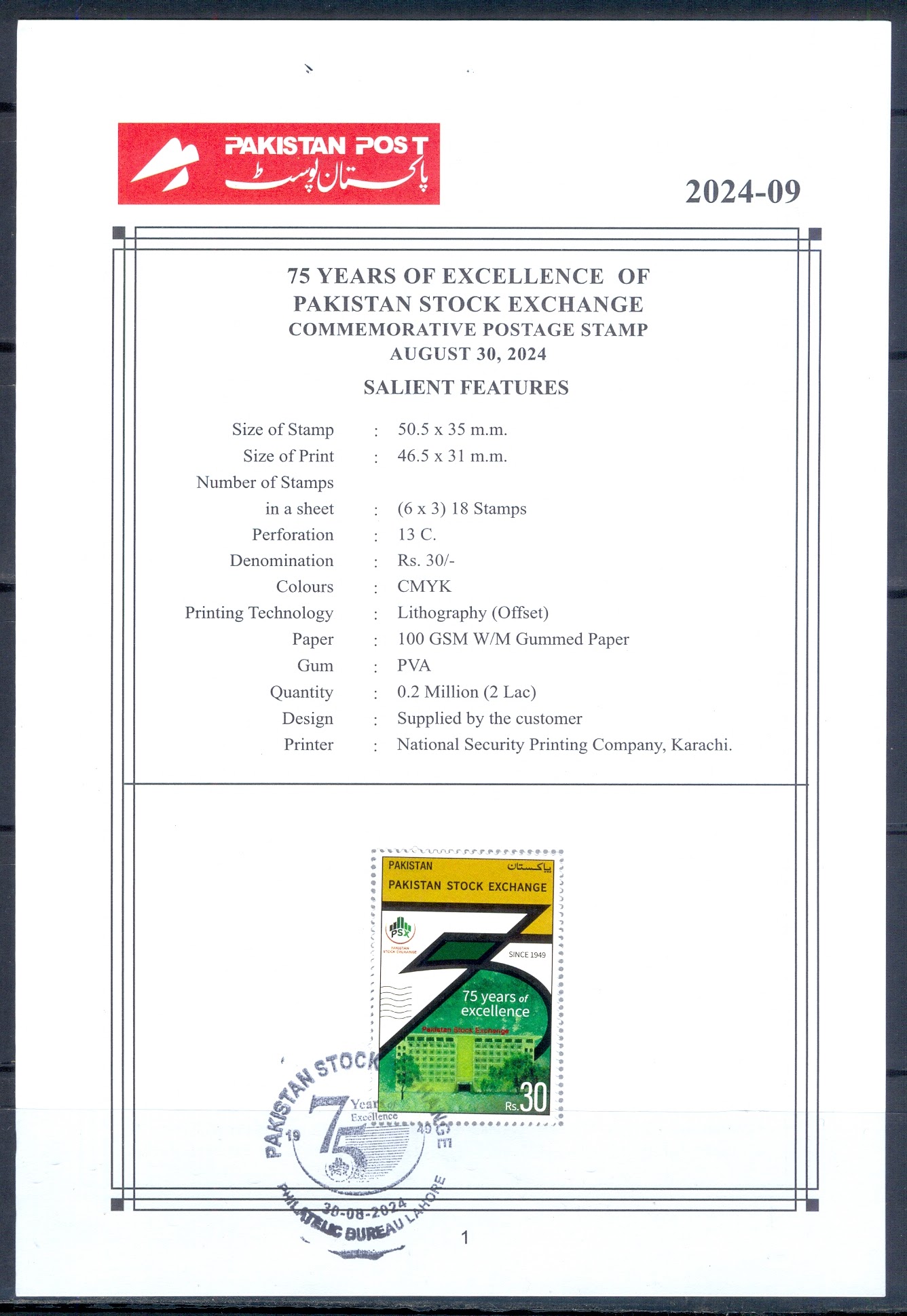
75 YEARS OF EXCELLENCE OF PAKISTAN STOCK EXCHANGE. AUGUST 30, 2024 (2024-9)


Pakistan Stock Exchange (PSX) is the national stock exchange of Pakistan. It was established with the name of Karachi Stock Exchange (KSE) on September 18, 1947. It was incorporated on March 10, 1949, under the name of Karachi Stock Exchange. (Guarantee) Limited as a company limited by Guarantee. In October 1970, a second stock exchange was established in Lahore by the name of Lahore Stock Exchange (LSE) to meet the stock trading or investment and listing needs of the provincial metropolis of Lahore and its surrounding region. In October 1989, a third stock exchange was established in Islamabad by the name of Islamabad Stock Exchange (ISE) to cater to the investors and companies of the northern parts of the country.

Originally, KSE was a small bourse having only five listed companies with a total paid- up capital of Rs 37 Million. As the years passed and more companies got listed, the first index constituting the companies on the bourse was formed. It was called the KSE 50 Index. Gradually, as the number of listed companies and trading activity increased, the need for a truly representative index was felt and the KSE 100 Index was formed on November 1, 1991. Other indices such as the KSE 30 Index and KMI 30 Index along with the recently added sectoral & ETF indices were also added, thus bringing a total of 16 indices on the Stock Exchange at present.

In the earlier days, trading of shares used to take place through open outery on the trading floor. This was a traditional way of communication between stockbrokers where verbal communication and hand signals were used for conducting transactions. One stockbroker would communicate that he was interested to buy a stock while another stockbroker would communicate that he was interested in selling a stock. Hence a buy sell deal was made across the trading pit. The open outcry method was eventually replaced in 2002 by the electronic trading system. The Karachi Automated Trading System (KATS) became operational at the Stock Exchange which was a robust, high performance and high-capacity trading system. This was later replaced by the New Trading & Surveillance System (NTS), a cutting edge, future-ready, and robust trading system, which was successfully implemented, installed and adopted in 2023.

The three stock exchanges, Karachi, Lahore & Islamabad stock exchanges had separate management, trading interfaces, indices and no mutualized structure. In March 2012, the Stock Exchanges (Corporatization, Demutualization, and Integration) Act 2012 was passed by the Parliament of Pakistan and in the month of May of the same year, it was signed by the President of Pakistan. By virtue of the said Act, all three stock exchanges were converted into companies limited by shares and it resulted into separation of ownership rights with the trading rights. The brokers were termed as initial shareholders who were issued shares of respective stock exchanges together with Trading Right Entitlement Certificates (TRECs). The said Act also required all the stock exchanges to divest 40% of their equity to strategic anchor investors and 20% to general public.

In order to implement the condition of divestment of shares laid down in theabove-referred Act in letter and spirit, it was essential to have only one stock exchange available for this purpose to the potential investors. As such, the operations of all three stock exchanges were ultimately integrated and a single entity with the name of Pakistan Stock Exchange Limited (PSX) emerged on January 11, 2016. It was followed by sale of 40% equity stake of PSX to Chinese consortium in the end of 2016 and offer of 20% equity stake to general public and self-listing of PSX in June, 2017. As such, PSX is now a commercial entity as well as an active frontline regulator of the capital market.

Many developments have taken place at PSX over the last few years. These include upgradation of PSX technology platform wherein a new Trading & Surveillance System has been implemented at the Exchange as mentioned earlier. Furthermore, the Exchange has brought forth new technological innovations and conventional developments such as the Online Account which allows investors to open an account digitally, the Sahulat Account which requires a simplified and convenient account opening process, the PSX WhatsApp Service to make available a host of information to users on their finger-tips, the My Portfolio virtual trading platform to enable users to learn the ropes of investing through real time trading but with virtual cash, the PSX Knowledge Center which is a repository of articles, blogs and financial calculators related to the capital markets, and the PSX Glossary which consists of a list of 500 terms and definitions to enhance and increase knowledge on the financial markets. Over the past few years, nine Exchange Traded Funds have also been launched at the Exchange. These ETFs belong to different categories such as those of equity, debt and Islamic. Moreover, PSX caters to those investors as well who are inclined towards Shariah compliant investments. In this context, PSX lists 258 Shariah-compliant companies amongst its listings.

The ecosystem of the Capital Market of Pakistan comprises of different parts which together enable the working of the Market as a whole. The companies at the forefront with PSX in the ecosystem of the Capital Market of Pakistan are Central Depository Company of Pakistan (CDC) and National Clearing Company of Pakistan Limited (NCCPL). CDC handles the transfer of shares traded and keeps the custody of shares held by investors electronically while NCCPL provides clearing and settlement services of shares and funds against the transactions conducted at the Exchange. The apex regulator is the Securities & Exchange Commission of Pakistan (SECP) under whose regulations, PSX operates. The securities brokers, capital market intermediaries, and the Asset Management Companies (AMCs) are an essential part of the capital market ecosystem as well.

Pakistan Stock Exchange lists 523 companies on the Main Board and 3 companies on the GEM Board, representing 36 industrial sectors having total market cap of over Rs9,947 trillion. In recent past, PSX outperformed the stock markets of the world and was called the world's second-best stock market by Bloomberg in October 2023. PSX was also the proud winner of Best Islamic Stock Exchange Award for three consecutive years, 2021, 2022, 2023, presented by Global Islamic Finance Awards (GIFA).

Pakistan Stock Exchange plays a crucial role in the country's economy as it channels domestic savings and foreign capital to the financial coffers of the country. By attracting interest from local and foreign investors, much needed capital inflows are channeled in the country through PSX. There are more than 318,000 investors investing on the Exchange. Pakistan Stock Exchange provides for an attractive avenue of investments with Price to Earning Ratio of 3.80 which is the lowest in the region. This is a clear reflection of the attractive valuation of stock prices prevalent at PSX. Not only that, Pakistan Stock Exchange has provided the highest Dividend Yield of 9.38%as compared to other markets of the region.

Not only for investors, but also for companies, PSX is an attractive capital market. By listing on the Stock Exchange, companies can obtain much needed financing to fund their growth, invest in new projects, and increase the country's exports. Companies listed on the Exchange provide employment and benefits to thousands of Pakistanis and their families and generate significant tax income for the Government of Pakistan.

On the occasion of completion of 75 Years of operations of Pakistan Stock Exchange, a Commemorative Postage Stamp of Rs. 30/- denomination is being issued by Pakistan Post on 30th August 2024.

Thursday, August 22, 2024

75TH ANNIVERSARY OF ESTABLISHMENT OF DIPLOMATIC RELATIONS BETWEEN PAKISTAN AND EGYPT. AUGUST 21, 2024 (2024-8)


Pakistan and Egypt have close fraternal relations, which are characterized by common bonds of faith, cultural affinities, and values between the people of two countries. Egypt was among the first countries to recognize Pakistan and the two countries exchanged resident Ambassadors in 1948. The relations between the two countries have strengthened more and more. Pakistan and Egypt have bilateral relations in the political, economic, trade, investment, education, cultural and defence fields. The two brotherly countries are celebrating 75th Anniversary of establishment of diplomatic relations.

2. Pakistan and Egypt are the promising developing economies with thriving young population. Both countries have economic and infrastructure development as the central agenda moving forward. They continue to highlight Islamic traditions and crafts in their modern infrastructure.

3. Islamabad is the new national capital of Pakistan, that was built in 1960s to replace Karachi as a capital. It is located on Pothohar Plateau of the northern Punjab region. As per the latest census in 2023, Islamabad Capital Territory has a population of 2.36 million. Islamabad is a lush green city with healthy climate. It is a modern and carefully planned city with wide roads and avenues, elegant public buildings and well-organized markets, and shopping centres. The metropolitan area of the city is divided into eight basic zones: Administrative, diplomatic enclave, residential areas, educational sectors, industrial sectors, commercial areas, and rural and green areas. Islamabad is a symbol of modern state representing vibrant and progressing nation of Pakistan.

4. Located on the foothills of Margalla hills, Islamabad has a scenic mosque in its centre with the name of Faisal Mosque. The mosque was built in the name of Saudi King Faisal Bin Abdul Aziz. Sprawling on 33 acres, it is now the sixth largest mosque in the world. The construction started in 1976 and the mosque was completed in 1986. Faisal Mosque was designed by Turkish Architect, Mr. Vedat Dalokay. It has unique and unconventional architecture. The main 8-sided hall of the mosque was designed in a way that it looks like a Bedouin desert tent. It has four minarets. It has the capacity to host 300,000 people for prayers.

5. To fulfil the increasing administrative needs and to accommodate the rising population of Cairo city, the Egyptian government has undertaken massive infrastructure project of building a new area, currently named as The New Administrative Capital (NAC). It is planned to be Egypt's new capital and has been under construction since 2015. NAC is a part of Egypt's agenda for economic development and larger initiative called 'Egypt Vision 2030'. The new city is located 45 kilometres (28 miles) east of Cairo and just outside the Second Greater Cairo Ring Road. Sprawling over 700 km², the city is expected to house a population of 7 million people. The city is planned to consist of a government administrative district, a diplomatic area, a cultural district (opera and theatres), a central business district (CBD), parks (the 'green river'), and 21 residential districts. The NAC would be completed in phases. Egyptian government has already started shifting government ministries to the New Administrative Capital in 2023.

6. To symbolize the modern architecture and Islam as basic essence, Egypt built a spectacular mosque in its New Administrative Capital, named Al-Fattah Al-Aleem Mosque. The mosque is located on the New Middle Ring Road in the New Capital. Al-Fattah Al- Aleem Mosque has been built on the allocated area of 110 acres and is considered one of the mega mosques in the world. Like Faisal Mosque in Islamabad, Al-Aleem Mosque is the hallmark of the development of New Administrative Capital in Egypt. It was inaugurated by Egyptian President Mr. Abdel Fattah el-Sisi in January 2019. The mosque has 21 domes and four minarets each of nearly 95 m in height. and is considered the 2nd biggest mosque in the world in terms of total area. Currently, the mosque has a capacity to house 17,000 people for prayers. The mosque also includes two Quran memorization houses one each for boys and girls.

On the 75th Anniversary of establishment of diplomatic relations between Pakistan and Egypt, the commemorative postage stamp is being issued by Pakistan Post of the value of Rs. 75/- each denomination on 21st August, 2024.

Monday, August 19, 2024

Second Death Anniversary Ustad Nusrat Fateh Ali Khan (1948-1997) (1999-8)


Nusrat Fateh All Khan can truly be described as one of the greatest musical prodigies of our times.

Although he was an exponent of the Qawali (mystic) singing but he used his musical skills of the classical art form of music to blend it with contemporary music to an extent that he can be called the pioneer of this individualistic style by harnessing the vocal of his high pitched voice that depicted the cry and pathos of the common man.

Born to a distinguished family from Jalandher with a 600 year-long tradition of performing Qawali, his deceased father and uncles are still remembered as great masters of Qawali.

Mr Nusrat began to seriously pursue Qawali career only after the death of his father. However, since his debut in 1965 as the lead singer of the group, he had distinguished himself as a qawal - a singer of Qawali music. He was known as the “Shahenshah-e-Qawall” - the king of Qawali.

Nusrat Khan continued to perform Qawali in religious rites - the original form in which Qawali is sung-at mausoleums of revered saints in Pakistan, while at the same time giving concerts at more convenient venues.

The superb singing talent and musical skill of this great master of Qawali, alongwith his strong command of Urdu, Farsi (Persian) and his native language, Punjabi, had enabled him to sing the mystic poetry 4 written in these languages with fluency and expressiveness.

He was also famous for his unparalleled repertoire, which extended to several thousands of songs. In appreciation of his excellence, the Government of Pakistan award him the President’s Pride of Performance in 1987.

In the summer of 1985, Mr Nusrat Fateh All Khan performed at the World Music arts and Dance festival (WOMAD) in London, where he stood out as the most promising singer. After the success of that summer, he began to perform music more freely.

His various experimentation, such as the use of seat-like singing improvisation, brought a fresh breeze into the traditional world of Qawali. His concerts in Paris in 1985 and 1988 were received with great enthusiasm as his amazing vocal performances produced a craze for his music throughout Europe. His first visit to Japan took place in 1987, at the invitation of the Japan Foundation.

His participation in seminars and his performance atthe 5th Asian Traditional Performing Art Festival and subsequent concerts in Japan had earned him a steadily increasing number of fans in this country.

These achievements, taken together had an immeasurable impact on cultural exchange between the East and the West, led to the enhancement of both cultures, and thus made Ustad Nusrat Fateh All Khan particularly worthy of receiving the Arts and Culture Prizes of various countries and made his name synonymous with International Music.

Khan Sahib was a regular performer of Pakistan Television ever since its inception, in Qawali programmes but with his amalgamation of modern music in traditional music, the demand of his songs, as a soloist became more in the enthusiastic young crowed.

To cater to this demand PTV also launched a series of musical programmes entitled “Nusrat Fateh All Khan Show” which was aired for three months on weekly basis.

His international tours with regards to his musical performances to experiment and inter-act with the diversified musical skills of musicians of international repute earned him unparalleled place.

He could undoubtedly be acclaimed as the cultural ambassador of Pakistan He died on 16th August, 1997.

Courtesy: Pakistan Television Corporation.

To commemorate the 2nd Death Anniversary of Music Maestro Pakistan Post Office is issuing a commemorative postage stamp of Rs 2 denomination on August 16,1999.

Sunday, August 18, 2024

Pioneers Of Freedom Series (1999-7)


Mr CHAUDHRY MUHAMMAD ALI (1905-1980)

The late Chaudhry Muhammad All, former Prime Minister of Pakistan was born in 1905 in Nagal Ambia, a village near Jullandar, Punjab into a family of agriculturists.

After completing his education Chaudhry Sahib appeared in the civil services examinations and was inducted into the service in Audit and Accounts Group. He rose rapidly through the ranks of the services.

He served for a time as the Accountant-General to the Nawab of Bahawalpur and thereafter was transferred and posted at Delhi. The eve of Second World War found him as one of the very few Muslims who had secured a high position in the Government of India. By 1945 he was appointed Financial Advisor, War & Supply and was the first Indian to hold this key position.

By the early 40’s the struggle for independence had entered into a critical phase, Chaudhry Sahib became a close aide to the Quaid-e-Azam.

The complete trust that the Quaid-e-Azam had in Chaudhry Sahib is demonstrated by the fact that he was the person chosen by the Quaid to represent Pakistan as one of the two members of the Steering Committee through which the Partition Council acted, dealing with all those vital issues which had to be decided before partition.

Pakistan was represented on the Partition Council by the Quaid-e-Azam and Liaquat Ali Khan. At that time Chaudhry Sahib was but barely in his early 40s and it speaks volumes for his ability, integrity and complete dedication to the Muslims’ cause that he was chosen by the Quaid himself to act in such a sensitive and key position.

In 1946 the Interim Government in India composed of members of Congress on the one hand and the Muslim League on the other. The Muslims were, because of heir lack of education and experience in commercial and financial matters, typically regarded by the Hindus as incapable of having, and indeed lacking in any financial sense at all.

At the urging of Chaudhry Sahib himself, the Muslim league accepted the Finance portfolio and on February 28, 1947 Liaquat All Khan, who held the portfolio of Finance Minister, presented his budget.

This was the first budget made by a non-British Finance Minister in undivided India; it was also the last and most controversial. The entire work for the preparation of this budget was done by Chaudhry Sahib himself.

The budget is known to history as the Poor Man’s Budget and it produced consequences of fundamental importance at that key stage of the struggle of independence. The budget directly hit the Hindu Mahasaba, ie the leading Hindu capitalists and businessmen, where it hurt them the most, namely, in the their pockets.

The budget brought home to the Hindus like nothing else before it, the fact that in a united India, the relatively poorer Muslims would constantly demand in the name of social justice, a share in the wealth of Hindus.

The Budget proved to be and served as, the final proverbial straw that broke the back of the camel and led to the acceptance by the Congress leadership of the fact that the sooner the Muslims were got rid of by partition, the better.

Thus, at the most critical juncture and on the eve of the most crucial period in the emergence of Pakistan, Chaudhry Sahib’s efforts led directly to the final step that ended in the creation of Pakistan.

After partition Chaudhry Sahib was appointed, again on the direct instructions of Quaid-e-Azam and Liaquat All Khan, as the very first Secretary General of Pakistan, a post that was specifically created to deal with the problems of setting up a newly state virtually from scratch. He also held the post of Cabinet Secretary.

A few years later at the request of Liaquat All Khan and Khawaja” Nazimuddin, Chaudhry Sahib reluctantly left the security of Government service, and entered politics. He held the post of Finance Minister and subsequently became Prime Minister of Pakistan in 1955.

It is a historical fact that he is the only Prime Minister of Pakistan to have resigned his post although enjoying the confidence of the majority of the Central Assembly, as the legislative house was known at that time.

He also had the honour of steering through the Central Assembly the very first constitution of Pakistan in 1956 which served as the model for all subsequent such endeavours in this country. After leaving office in 1956, Chaudhry Sahib remained actively involved in politics for a number of years till about 1970.

His struggles during the ‘60s, when he was the head of the Nizam-e-Islam Party, to oppose and dislodge the regime of Ayub Khan are too well documented and known to require any detailed examination. The important part that he played in the presidential campaign of Mader-e-Millat Fatima Jinnah at that time was only one chapter in the long struggle.

Although Chaudhry Sahib had suffered a major heart attack in 1953, that never Deterred Or stopped him in his ceaseless efforts to serve the nation. However, in 1970 he suffered another heart attack and this time the doctors told him that his health could not take such strains any longer and that he would have to necessarily retire from active politics.

He did so only with the greatest reluctance. Thereafter he assumed the role of a senior statesman in the country.

His doors always remained opened to all who sought his advice on matters large or small and he was unofficially consulted several times by various dignitaries and other important personalities.

The selfless devotion with which he had ceaselessly toiled throughout his life for the service of the nation had however, taken its toll in his health. He suffered a series of heart attacks throughout this period and finally left this earth for his heavenly abode in December, 1980.

Quite apart from his public service and career, Chaudhry Muhammad Ali did one more outstanding service for Pakistan.

This was his monumental work, The Emergence of Pakistan, which describes in detail the events that led to the creation of Pakistan. According to one reviewer of the work, “Chaudhry Muhammad Ali has given his readers just the kind of inside view that Liaquat All Khan and Quaid-e-Azam himself would have written, had the opportunity been given to them.

Much has been written about the period involved by British and Hindu writers; it took a man of Chaudhri Sahib’s calibre to present, definitively and elegantly, the Muslim perspective to the world.

The book reviews and presents a critical stage in the history of our nation with clarity, depth and vision.

Contributed by the Chaudhry Muhammad All Charitable Trust.

SIR ADAMJEE HAJI DAWOOD (1880-1948)

Late Sir Adamjee Haji Dawood was born in Jetpur, a small town in the present Gujrat state of India in 1880. His education was though limited, he had an immense potential in trade and commerce which led to his early business career at the age of 15 in Rangoon, Burma.

In a short period of time, Adamjee made phenomenal progress in business and was probably the first Muslim to enter into the field of Industry. In 1923 he established his first industrial venture by setting up a match factory in Rangoon.

In 1927 he further expanded his business by setting up a Jute Mill in Calcutta, which became the first Muslim owned public limited company in India. Adamjees outstanding performance earned him recognition in various business and political circles and he was elected the first President of All India Muslim Chamber of Commerce.

Sir Adamjee took keen interest in philanthropic activities, as welfare of the Muslims was a subject close to his heart. During his life Adamjee established many welfare institutions such as Adamjee Hospital in Jetpur and several student hostels all over Muslim India.

Apart from this be founded the Memon Educational and Welfare Society in 1933 and collected funds to mitigate the sufferings of the people of Bengal, Bihar and Quetta on account of natural calamities in 1933-35.

Adamjees work was recognized and appreciated by Mr Muhammad All Jinnah, Mr Gandhi, Nizam of Hyderabad Deccan Sir Mir Usman Ali Khan and several British Generals. Mr Jinnah and Adamjee became close friends and Adamjee was appointed Treasurer and Financial Advisor of the Muslim League and All India Press Fund.

At the request of Mr Jinnah, Adamjee was put incharge to oversee the problems faced by Muslims businessmen due to Hindu domination. Adamjee identified two major areas that needed attention, and alongwith the support of Mr M.A.H. Ispahani established the Muslim Commercial Bank and Orient Airways in 1946. After partition the Orient Airways was transformed into Pakistan International Airlines.

In 1938, King George VI awarded Knighthood (The title of Sir) to Adamjee in appreciation of his social activities.

Sir Adamjee’s greatest contribution was at the time of partition when the Government of Pakistan fell in financial emergency and was in urgent need of funds. Quaid-e-Azam Mohammad Ali Jinnah called upon Sir Adamjee to contribute in this cause and Sir Adamjee said whatever I possess belongs to Pakistan’ and handed over a signed blank cheque to Mr Jinnah. Sir Adamjee was then again called by Quaid-e-Azam for discussion for the establishment of State Bank of Pakistan where he suffered a Heart Attack and collapsed after that meeting on 26th January 1948. Quaid-e-Azam made a public announcement on the death of Adamjee.

“I am deeply grieved on the sad demise of Adamjee Haji Dawood. He was a True Muslim. He gave full support in the struggle of freedom. We have lost him when we needed him the most. It is very difficult to fill his gap in the business community of Muslims. His death is a big blow for Pakistan.

MAULANA ABDUL HAMID BADAYUNI (1898-1970)

Maulana Abdul Hamid Badayuni was a religious scholar and renowned leader of Pakistan Movement. Educated at Badayun he started teaching at Madrassa-i-Shamsul Uloom, Badayun. In due course he became a Mufti.

Participated in National Movements, specially in Khilafat Movement and Anjuman-i-Khuddam-i-Kaba. Associated with All India Muslim League since 1918, but after the reorganization of All India Muslim League. Spoke at Minto Part in support of Lahore Resolution in March 1940.

Popularised the demand for Pakistan throughout India by delivering speeches. Member, All India Council of All India Muslim League.

Called All India Sunni Conference at Banaras in 1946 to support Pakistan on religious basis, worked for the organization of jamiat-i-Ulama-i-Pakistan and became its president. Founded Jamia Taleemat-i-Islamia at Karachi. Died in 1970 and buried at Karachi.

Courtesy: Quaid-e-Azam Academy, Karachi.

To commemorate the Pioneers of Freedom Pakistan Post Office is issuing a set of 3 commemorate postage stamps of Rs 2 (each) denomination on August 14, 1999.